by
by 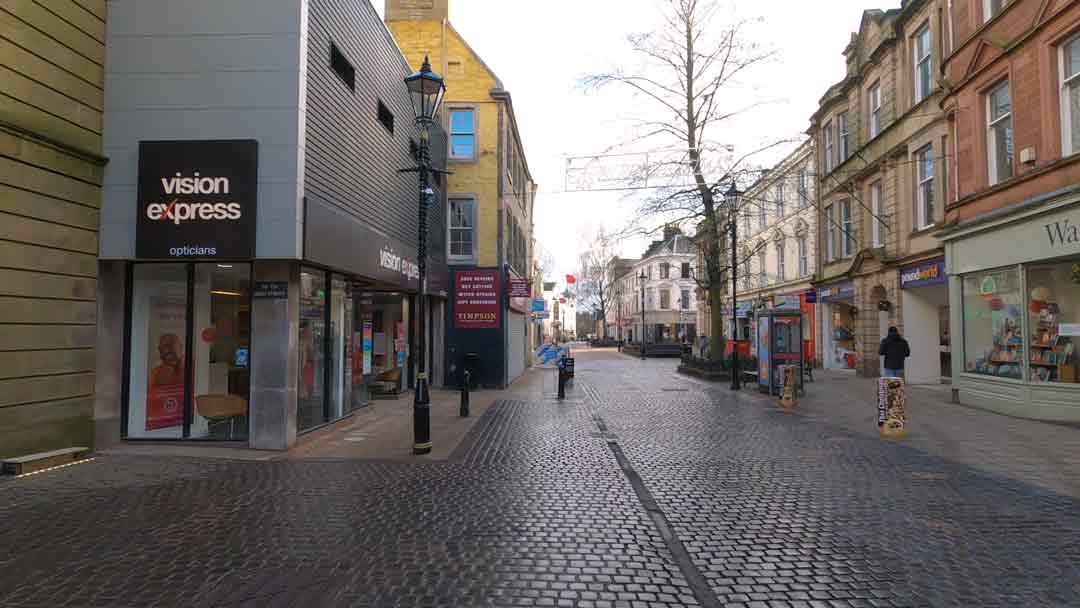
Falkirk during lockdown, virtual walk (video)
Falkirk
This city has three different sounding names, one large oil refinery and as many as ten cool attractions! And all this fit into 13.8 square kilometres of area.
Can you guess what we’ll be talking about? Of course, about Falkirk – a Scottish city with a very long history and an extremely interesting present!
“What’s in your name?”: why Falkirk has three names
Falkirk is a Russian-language name that phonetically coincides with the authentic “Falkirk” – this is how the proper name of the city sounds in pure English. Since two other languages are spoken in Scottish cities – Gaelic and Anglo-Scottish – the city has a couple of other unambiguous names.
This is what Falkirk is called by the Gaels and Scots:
- An Eaglais Bhreac (in Gaelic);
- Fawkirk (Scots Gaelic).
The very first name of the city was the Gaelic An Eaglais Bhreac, translated into Russian meaning “motley church”. The fact is that in the early Middle Ages missionaries came here and built the first Christian church.
In honour of such an event, the indigenous population who accepted the new faith decided to call their city “the motley (or speckled) church.” The fact is that it was erected from stones of different colours.
By the way, the Scottish version of “Fawkirk” is not translated similarly: “heterogeneous church.”
Geographical location of Falkirk
The small settlement is located neatly in the middle of the country, in its “heart” in Fort Valley. Actual distances to nearby major cities are as follows:
Administratively, Falkirk belongs to the municipal district of the same name – the district, being its centre.
The district’s “neighbours” are three other districts:
- West Lothian – from the southeast.
- North Lanarkshire – from the southwest.
- Stirling – from the northwest.
The fourth neighbor of Falkirk is separated by the Firth of Forth: on its opposite shore is the county of Clackmannanshire.
The city is “surrounded” by five towns (Denny, Grangemouth, Boness, Larbert and Stenhousemuir) and several villages of Brays which contain 1/5 of the total population of the district.
From the Roman Empire to the present day: a shortened history of the city
According to surviving artefacts and other silent “witnesses” of the past, Falkirk was built by Antoninus Pius (i.e. the pious), the fourth of the five so-called “good Roman emperors” who received the eloquent nickname of the Father of the Fatherland.
Antoninus Pius ruled from 10 July 138 to 7 March 161 in order to expand the borders of the Roman Empire and ordered the construction of a new defensive rampart in Scotland made from turf which turned into a strategic object. It was called the “Antonine Wall” and stretched between two bays:
-
from the Firth of Clyde (east bank).
-
to the Firth of Forth (west bank).
The defensive rampart remained simply a man-made barrier for potential conquerors for quite a long time: no one specifically settled here and the area was used purely for the purpose of the military strengthening of its borders.
Everything changed around the 7th century AD when missionaries erected a wooden church near the defensive ramparts. Gradually the consecrated place was built up until it quickly became a large settlement.
Battles of Falkirk
In the old days, the blood of its defenders and enemies was shed twice on the lands of Falkirk.
The first time a battle took place was on 21 June 1298. On this memorable day Scottish troops, led by the national hero-patriot Knight W. Wallace, were defeated by the English army of King Edward Longlegs. The victorious king became gloomily famous for his particularly brutal suppression of Scottish uprisings for independence.
The second battle took place almost five centuries later. The reason for the battle of 1746 was an attack by the troops of the pretender to the Scottish and English thrones, Bonnie Prince Charlie, on the eight thousandth army of General G. Hawley. It is believed that on 17 January, the Jacobites, who besieged Falkirk Castle with government troops hiding in it, suddenly attacked Henry Hawley, who was not expecting the attack, and killed three hundred soldiers.
When did the settlement of Falkirk become a city?
The status of a burg was assigned to the fort settlement only in the leap year 1600. Having received the powers of self-government, Falkirk began to actively build up buildings made of wild stone.
Strictly speaking, only one city street was rebuilt: today it is called the High Street.
Industry of Falkirk
We can safely say that the origins of Scotland’s transformation into an industrial country are located here: in the 18th and 19th centuries the city was considered to have a real concentration of heavy (steel and iron) industry in the region! This was facilitated by three revolutionary events:
-
the construction of the Forth and Clyde Canal, completed in 1790, connecting the Firth of Clyde and the Firth of Forth.
-
rapid construction of the railway.
-
The Union Canal built in 1822 connected Falkirk with Edinburgh.
And back in 1759 the largest metallurgical plant in Europe was built near Falkirk (it operated until 1982). Technological advancement consisted of using coke as a fuel rather than the less heat-intensive charcoal.
Today, iron and steel are no longer smelted in Falkirk. The main sources of income is tourism and retail trade. In principle, the city can be considered one large shopping and entertainment centre.
Large industrial facilities
The Hovey family built the first brickyard in 1822.
Alexander Dennis, one of the world’s largest bus manufacturers.
3 World Famous Falkirk Landmarks
Here are three (but there are many more) interesting cultural and architectural sites that you definitely need to look at, at least once if you are lucky enough to visit the city!
“Kelpie” sculpture and “Helix” park
Giant (30 metres long) statues of The Kelpies – a pair of metal figures in the shape of horse heads weighing 400 tons.
Falkirk Wheel
The Falkirk Wheel is the very first ship lift in the world. The shape of the structure, with a diameter of 30 metres and a length of 28 metres vaguely resembles a Celtic double axe.


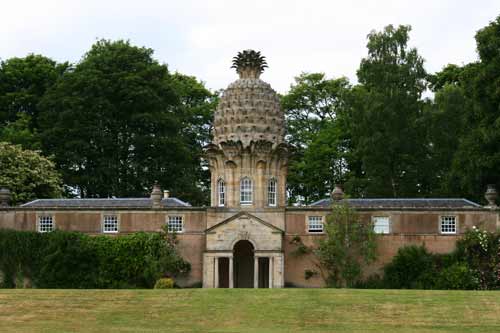
The Pineapple
The pretty building with a roof in the shape of a ripe pineapple was built in 1761 by the eccentric Lord Dunmore. The original architecture does not serve any practical purpose: “Pineapple” simply decorates the object, attracting tourists.
10 quick facts about Falkirk
-
Falkirk has “summertime”: from April to August inclusive, the clocks are moved forward an hour.
-
The climate consists of a coastal temperate, i.e. with a mild (no frost!) winter without heavy snow cover and not too hot a summer (the August 2010 record – 31.5 ° C).
-
Almost 36,000 people live within the administrative boundaries (resident density is approximately 2,602 people per 1 sq. km) – the 20th most populous settlement in Scotland.
-
The city lies in the Central Lowlands at an altitude of only 37m (121 ft) above sea level.
-
The ruins of the defensive rampart built by Antoninus Pius remain in Callendar Park Wikipedia, considered one of the historical landmarks of Falkirk.
-
In the 19th century, Falkirk became the first town in Britain to have a fully automated street lighting system (designed and built by local company Thomas Laurie & Co Ltd.).
-
On the site of the mediaeval mottled church stands Falkirk Trinity Church – the Old Parish Church of St. Modana (its 18th century spire is preserved).
-
During archaeological excavations carried out in the 40’s of the last century, huge deposits of Roman coins were discovered in the city.
-
There are only two railway stations in the city: Falkirk High and Falkirk Grahamston.
- In 2003, the folk wheel was named the best original work in the field of design.