


 by
by 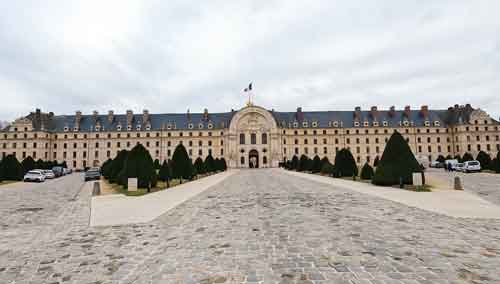
House of Invalides
Almost in the very centre of Paris, in the 7th municipal arrondissement, is a place unique in its architecture and history – the Hotel des Invalides. Today I want to tell you about this historical landmark as we walk through its courtyards and halls.

The home for the disabled is located in an area of 13 hectares. The complex includes various buildings: the Church of St. Louis (the dome of which pierces the sky with a golden spire), several museums, a hospital that is still in operation today and parks with neatly trimmed lawns and plantings.

The Invalides welcomes all guests with a facade which is about 196 meters long and in front of this is a large square with lawns where a number of French cannons and artillery shells are installed. Despite the minimalism of form, the facade is decorated with majestic lions, eagles, arrows and other elements that give it a more solemn, “lush” look.
Construction of the Invalides began in 1670 by order of King Louis XIV of France. This complex was supposed to become a place to house former military personnel who were injured in wars, which was not uncommon at that time. The house received its first guests in 1674 and by 1714 their number reached 4,000 military personnel of various ranks. The personnel servicing the complex were also constantly located here.

An arched passage leads from the main square to the complex’s courtyard. The shape of the yard has the appearance of a clear rectangle and the entire internal area is paved with paving stones. The architecture of the complex is crowned with the 107-metre dome of St. Louis Cathedral, decorated with gilded lilies and topped with a lantern with a spire.


The front yard is also home to one of the largest collections of artillery pieces. Here, 60 bronze cannons, various mortars and howitzers are lined up in an even row. Walking along the corridors of the courtyard will tell you about the two-hundred-year history of French artillery, clearly demonstrating its best examples.


However, despite the large number of historical artifacts, the Cathedral of St. Louis is the most outstanding and significant centre of the entire complex, both from a cultural and historical point of view. The sanctuary was built from 1679-1706. The project was created by the architect Jules Hardouin-Mansart.
Saint Louis Cathedral
The geometry of the cathedral is a circle with a square with clear proportions and minimalist lines. The plan of the sanctuary follows the Greek cross exactly. The structure has a protruding part divided into two tiers which is decorated with monumental columns, bas-reliefs and the fleurs-de-lis of the Bourbons. There are statues of Charlemagne and Louis XIX on both sides of the entrance.

The dome of the cathedral attracts special attention. This is a complex structure with windows through which light penetrates inside. The dome is decorated with decorative lines and the top is crowned with an openwork lantern and a high spire. In 1989 twelve kilograms of real gold was spent on the reconstruction of the dome.

There are tombs with the ashes of famous military men and generals of France under the dome of the Cathedral. The interior of the sanctuary was created to glorify the monarchy of King Louis XIV and his military achievements. The vaults of the hall are decorated with images of the four evangelists. The ceiling and walls are decorated with stone and gilded frescoes.


The central hall of the cathedral is connected to four round chapels. They serve as tombs for members of the Bonaparte family and famous military figures of France. There is the mausoleum of the Marshal of France, Sebastian Le Prestre, Marquis de Vauban made of black marble and the tomb of Joseph Bonaparte, Napoleon’s brother, the chapel where Marshal Foch is buried and the tomb of Jerome Bonaparte.


Tomb of Napoleon I
The Cathedral of St. Louis became the last tomb of the outstanding commander of France – Napoleon Bonaparte I. A tomb where the ashes of the French emperor rests is laid underneath the dome of the sanctuary in the crypt. Napoleon died on the island of St. Helena in 1821, but his remains (at the behest of Louis Philippe) were transported to his homeland in 1840. In that same year a law was passed stating that the tomb of the Emperor was to be built under the dome of the Cathedral. Visconti began work on the construction of the church. The remains of Napoleon I were officially buried in the Cathedral in 1861 and the ceremony was attended by Napoleon III himself.

Napoleon’s ashes are sealed in six coffins (made of tin, mahogany, lead, ebony and oak) and are placed in a sarcophagus made of red Karelian stone. It is installed in the centre of the cathedral on a green marble pedestal. The sarcophagus and its lid are crowned with laurel crowns. The names of the emperor’s victories including the battle for Moscow are written in gold letters around the sarcophagus on the marble floor. The crypt is surrounded by twelve columns – twelve goddesses of victory by Pradier.


The appearance of the pedestal is truly impressive and mesmerizing as if demonstrating the greatness and eminence of Napoleon I over today’s world. In the round corridor you can see ten bas-reliefs by Simart which speak about the events which glorified Bonaparte.
The museums of the Invalides complex are no less interesting. The museum collection includes more than 500,000 exhibits from different eras and cultures which are in one way or another connected with the political, military and social life of France.
Военно-исторический музей
The Military Museum opened in 1905 and combines the Artillery and Military History Museums. Here are paintings depicting Napoleon, outstanding French military figures and great military battles. Here you can also see the emperor’s personal belongings and even his stuffed horse. In one of the halls visitors have a view of the reconstruction of the emperor’s living room and his deathbed.

The military-historical section of the museum covers the history of the state from Louis XIV to Napoleon III. Unique exhibits and antiques reveal the secrets of history down to its smallest detail and describe better than any historian the military and political life of France at that time.


A visit to the Invalides is a walk through the historical past of France and an acquaintance with unique objects and artifacts of the past. Today, approximately one hundred French Armed Force pensioners live in the Invalides. The main courtyard often hosts various performances and the museum itself is open to the public all year round.


