


 by
by 
Mainland
A walk to Mont Saint-Michel Abbey is a real journey into a parallel universe because this amazing place is unique not only for its centuries-old history, but also for its unusual geographical location.

My acquaintance with the Mont Saint-Michel Chateau begins on the mainland which is connected to a rocky island by a modern bridge. You can get to the chateau either by using an electric bus which travels over the bridge or by going on foot. I chose the first option and took the bus to its final stop from which you need to walk about 300 metres to the entrance of the abbey.
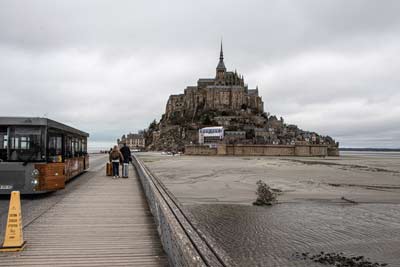
So, after getting off the bus I had a magnificent view of the rocky island of Mont Saint-Michel. Even the overcast weather and lack of sunshine could not mar my first impression. The island rises sharply against a background of a flat surrounding bay, the endless smoothness of the water and small thinnings of grass. The top of the mountain is crowned by a monastery whose spire pierces the clouds overhanging the island. Various buildings and houses are also visible on the slopes. After walking a little further over the bridge I came, finally, to the impregnable stone walls which surround the island.
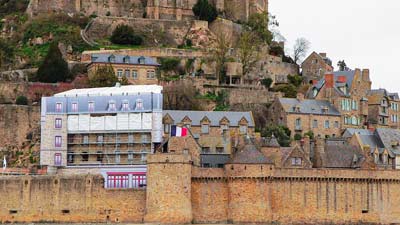
The island is a cone-shaped granite formation which rises 79 metres above sea level. The entrance to the impregnable fortress of Mont Saint-Michel begins at the protruding gate of the fortress wall and is called the Royal Gate. Once inside the abbey, standing at the foot of the cliff, it was as if I had been transported back to the era of kings and knights – so atmospheric does this place look and the air here is permeated with history and legends from the past.
Ancient architecture
After walking a little more, I found myself on the main street of Grand Rue. There are numerous old houses built in the 15th-16th century, the ground floors of which are given over to souvenir shops and cafes. A stroll along this picturesque street is very entertaining as it is an example of how antiquity harmoniously co-exists with modernity: bright shop windows filled with modern goods are juxtaposed with stone ledges and bas-reliefs, ancient lanterns and coats of arms of noble families hang on the walls and twisted ivy stalks cover cosy small balconies in which you can see the apartments of stylish hotels.


The winding street led me to the start of a steep and rather long staircase leading up to the abbey. There are also stands here which tell the story of the castle’s creation. According to legend, Bishop Aubert received a dream from Archangel Michael who ordered him to build a church on the Grave Mountain (the name of the island at the time). However, construction began only after the archangel came to Ober in a dream for the third time and touched the bishop’s forehead with his finger so that he would believe and proceed.


The first stone of the small chapel was laid in 709. The bishop soon settled 12 canonist monks who were to maintain the cult of the saint on this impregnable mountain. From then on, Graves Mountain became a pilgrimage site for hundreds of clerics and it was renamed Mont Saint-Michel (Mount St Michael).
In 966, when the island was given to the Benedictine monks, the construction of a magnificent abbey began, which became the most venerated site in the Middle Ages. Soon a monastery was built on top of the island and the island was surrounded by a fortress wall which turned it into an impregnable fortress. French revolutionaries seized the island in 1792 and turned it into a prison, nicknaming it “provincial Bastille”. It was only under Napoleon III in 1863 that the prison was abolished and in 1979 Mont Saint-Michel was added to the UNESCO World Heritage List, where it remains to this day.
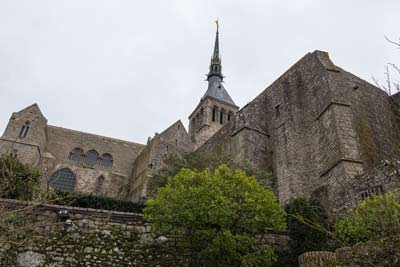
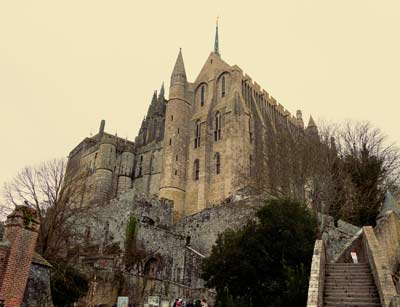
As I walked up the stairs I noted that the architecture of the different parts of the abbey belonged to styles from different eras: classicism, gothic and neo-Romanesque. However, contemplating these buildings, you realise how much they harmonise with each other, forming a unified ensemble of medieval architecture.

After a long climb I reached a large and spacious observation deck. It offers a stunning view of boundless distances. By the way, it was by viewing the beauty from this height that I could well visualise what the area looks like at high tide. The local tides are considered to be the most powerful and the fastest in all Europe. The water level changes every 24 hours and 50 minutes. The speed at which the water comes ashore is 6 kilometres per hour. And during low tides, the water recedes from the shore for 20 kilometres to return to protect the fortress.


It is this peculiarity that made Mont Saint-Michel invulnerable and impregnable to those who repeatedly tried to seize it. Not even the English, who besieged the castle for 30 years during the Hundred Years’ War, were able to seize it. Even as the water receded from the walls of the fortress, cavalry and guns could not advance through the quicksand which lined the bottom of the bay and infantry wilted in the sands. The rapidly arriving water covered the enemy and gave them no chance to reach the walls of the abbey.

Monastery
After admiring mind-blowing views, I entered the main attraction of the mountain, the Abbaye du Mont-Saint-Michel Church. Its spire rises to a height of 170 metres and on its top is a statue of the Archangel Michael, which also serves as the structure’s lightning rod.


I was greeted first by the Romanesque Nave of the cathedral, decorated in the “flaming Gothic” style. Powerful columns and sharp-angled windows going high up create an impression of infinity and an excessive height in the room. Despite the fact that many of the abbey’s buildings were destroyed and could not retain their original appearance, this part of the church has survived to this day in almost pristine condition, just as it was in 1086.


Walking through the rooms of the monastery, here and there I met interesting compositions and elements of architecture. I was very impressed by the inner courtyard – the circular procession of the Cloister. Dozens of Gothic columns are lined up in rows, framing a beautiful green area, on which the monks of the monastery once walked in the distant past.

The next room I could see was the refectory and after a few more stairs I found myself in the Knights’ Hall. After walking round the abbey, going out and then diving again into narrow openings and open doors, I found myself in the Guest Hall. My attention was drawn to the enormous fireplace, in which, according to legend, tree trunks were burned whole to heat the monastery rooms and cook food.
After touring the monastery and really enjoying the architecture I saw, I went for a walk around the abbey walls to enjoy the beautiful views of the bay. Narrow staircases which turn every now and then to the side, lead me to the foot of the castle, circling the castle in a spiral. Whichever corner and whichever way I looked round, I was treated to breathtaking scenery from everywhere.
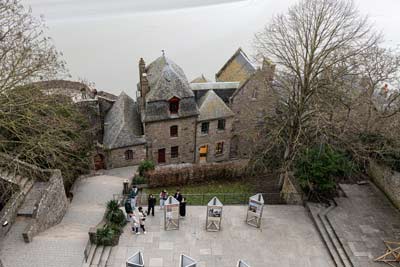
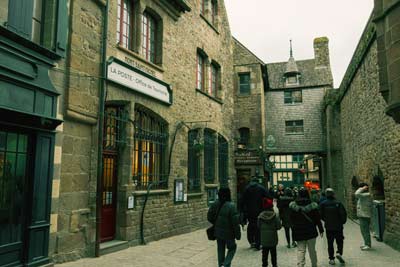
The walk around Mont Saint-Michel Abbey ends in the cosy streets of the town. The time I spent in this amazing place will definitely be remembered for years to come.


