'/%3E%3C/svg%3E)


 by
by 
Of all the ancient peoples of the British Isles, the Picts remain the most mysterious and continue to be the focus of attention for many researchers, archaeologists and historians. These warlike tribes did not have a developed written language and much of what we know about them today comes from external sources, many of which are vague at best.
Pictish Chronicle
The Pictish Chronicle is a very old manuscript which dates from the reign of Cinaed mac Mail Coluim, better known as Kenneth II, King of Scotland from 971 to 995 AD. This chronicle consists mainly of a historical list of the rulers of the Picts and although they were divided into separate clans or tribes, which often fought and raided each other, in times of difficulty they were united and were ruled by one leader.
King of One Hundred Battles

The name Drust often appears in different spellings: Drest and Drust are the most common. His father’s name is also spelled Erb, Irb or Urb. The name is often mentioned among the Picts and has been borne by many kings. Some argue that the name may be related to the name of Tristan, the famous hero of the Arthyrian legend. One version of the name Drust is Drustan (i.e. Tristan), and Drost or Drostan are almost exclusively royal names.
According to the chronicle, Drust I, son of Erb, was the first king of the Picts, reigning at the time when the Romans left Britain. It was a time of rapid change and was characterized by a somewhat chaotic, disorganized state of affairs. It is likely that Drust I emerged as a competent leader who could unite his people and benefit from the situation.

He is popularly known as the “King of a Hundred Battles” as the chronicle states that he “fought a hundred battles and lived a hundred years.” His actual reign is mentioned in various ways, with the most generally accepted being from 412 to 452 AD. Crucial to the reign of Drust is the fact that it was under his auspices that Christianity was first introduced among the Picts. This was done by Saint Ninian (died 432 AD), whose life coincides with the supposed reign of Drust I.
If a lifespan of one hundred years seems unlikely and mythical for that ancient period, then the “hundred battles” aspect may well be true. What little history we can piece together indicates that Drust I was very active in military campaigns.
It is likely that this king was responsible for the constant Pictish raids to the south so critically mentioned by Gildas the Wise in the 6th century. The Britons complained about the incessant invasions and raids of the Pictish and Scots tribes. As the Roman army gradually retreated south and then left Britain these northern tribes took advantage of the lack of military presence and penetrated deep into the south, raiding and plundering.
Of course, the tribes in the south responded to this threat and looked for ways to correct the chaotic situation which resulted from the raids. It is widely believed that due to these Pictish incursions, probably led by Drust I himself, Britons had no choice but to hire more and more Anglo-Saxon mercenaries to fight this threat from the north. This in turn led to an increase in the Anglo-Saxon presence in Britain and their gradual settlement there. Ultimately there was a huge increase in Anglo-Saxon culture and settlement in Britain in the 5th and 6th centuries AD.
Drust I was apparently quite capable of defending his southern borders against the Britons, Anglo-Saxons and invading Gaels. Not only did he wage offensive campaigns to reduce these threats, but he also created fortified harbours along the coastlines of his land to protect them from seaborne incursions. One of the sites in Scotland that is believed to be the main fort of King Drust I is known as ” True Hill ” and is located near the town of Gatehouse of Fleet in the parish of Anwoth, in the Dumfries and Galloway area. It is important to note here that the name “true” is a corruption of the word “Drust”. So, the location is literally called “Drust’s Hill” (Trusty’s Hill)
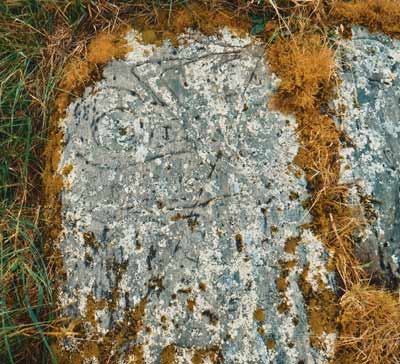
The fort is not very well preserved although some of its remains can be seen. It was partially excavated by a certain Charles Thomas in 1960 who confidently concluded that the fort dates from pre-Roman times, that is, long before the reign of King Drust I. Archaeological excavations have revealed traces of high-quality metalwork and large-scale celebrations which could indicate that it was an important and perhaps royal centre. However, at the entrance to the fort stands a carved Pictish stone carved with well-preserved Pictish symbols: a luxurious “double disc with Z-bar”, an elaborately carved sea creature and an image of a Pictish dagger. This Pictish stone is one of very few to have been discovered this far south outside the Pictish heartland. This may be due to the supposed raids of Drust I and the southern invasions which became such a big problem for the Britons.
As the first most likely historical king of the Picts, Drust I is also mentioned in Irish sources, mainly in the annals of Clonmacnoise (Annála Chluain Mhic Nóis). This early medieval manuscript, which was later translated into English, details historical events in Ireland and the region up to 1408 AD. It mentions Drust mac Erp (Drust, son of Erp), a Pictish king who reigned for 29 years and died in 449 AD. She also claims that it was in the nineteenth year of the reign of Drust I, around 435 AD that St. Patrick’s mission arrived in Ireland.
Darkened by time
Once we connect the dots, we can clearly see that King Drust I was a capable Pictish leader who rose to manage an unstable situation which arose in early 400 AD. As the Roman military presence waned, the way was opened for warlike northern tribes, whom the Romans were never able to completely subdue. Around this time, it is documented that Roman signal towers on the Yorkshire coast were burned and destroyed. This happened in the early 400’s and may well be one of the first moves of the Picts.
Another thing we know about Drust, Earp’s son, is that he exiled his brother to Ireland. He was known as Nechtan Morbet and was either exiled or fled to Ireland. This could indicate that Drust and his brother were feuding over power. Nechtan later returned home and became king of the Picts, reigning from 456 to 480, most likely after the death of his brother. Nechtan is said to have founded the village of Abernethy, which at one time was the capital and main political and religious centre of the Picts. The early monastery founded there was built on land donated by King Nechtan, son of Erp.
Pictish history remains largely obscured by time. With no written heritage and a turbulent history in the British Isles, the Picts’ fate was largely doomed from the start. What little we can piece together is fragmented and unclear, closely intertwined with myth and legend. However, if we broaden our horizons and consider the relevant historical events of the region, we can tell the story of early Pictish kings with some confidence. Drust I, son of Erp, is one such figure. Considering the historical events unfolding at this time, we can call him a historical figure.
King of a Hundred Battles
“King of a Hundred Battles” certainly seems the logical and plausible epithet that this king earned by using the empty space left by the retreating Romans to unite the Picts under one banner and wreak havoc among vulnerable British peoples. And it is likely that it was the actions of King Drust I that led to the gradual settlement of the Anglo-Saxons in Britain. This was one of the defining moments in the entire history of the British Isles, leading to the emergence of the history of the English people and, consequently, world history.