


 by
by 
Musée d’Orsay: how to go from an abandoned railway station to an art gem in Paris
Musee d’Orsay
The Musée d’Orsay Museum of Fine Arts lies between the famous Louvre in Paris and the Pompidou Centre on the left bank of the Seine River. There are amazing collections of European painting and architecture from the fourteenth to twentieth centuries within its walls. The building, which today is a stronghold of world artistic masterpieces, was originally built at the end of the 18th century when Napoleon Bonaparte decided to create the Ministry of Foreign Affairs here. However, in 1871 the Palace d’Orsay burnt down during the Revolution (Paris Commune) and was forgotten for 26 years


Construction of a railway station began on this site for the opening of the World Fair in 1900. The station and the adjoining hotel were erected for two years and opened on 28 May 1900. The building was designed by the famous architect Victor Laloux in eclectic style. It was the first electrified railway station serving Paris to Orléans. But by 1939 the trains stopped travelling in this direction and the station was closed.

Thirty years later the French wanted to demolish the Orsay station. But the French president proposed an idea to transform the area. As a result, in 1986, the luxurious Musée d’Orsay opened in the once abandoned station in Paris.
The uniqueness of the Musée d’Orsay in Paris
The Musée d’Orsay houses thousands of unique expositions of painting, architecture, sculpture, photography and other art forms from the late 18th to mid-19th centuries. The peculiarity of the collection of the Musée d’Orsay is that the exhibition continues the exposition of the Louvre and precedes the collection of the Centre Pompidou, observing the chronological sequence of the creation of masterpieces.

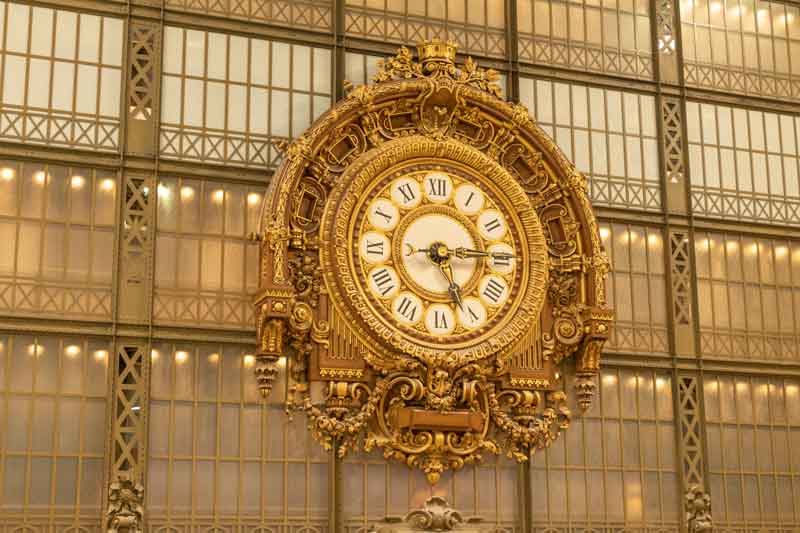
The exhibits are located on five floors. The ground floor is designed in the form of an old railway station – the glass arched roof refers to the historical past of the building.
Museum visitors are introduced to works of art on the ground floor which were created prior to 1870. The Orsay Museum’s collection includes more than 2,500 exhibits, some of which were previously exhibited in other museums and some of which were donated by private collectors.


The collection of paintings at the Musée d’Orsay
The collection of paintings includes works in the styles of realism, romanticism and impressionism. Most of the impressionist works were transferred from the Louvre to the museum’s collection. The most famous works in the collection are:
- Renoir – ‘Ball at the Moulin de la Galette’ (1876)
- Manet – ‘Olympia’ (1863).
- Monet – ‘Poppies’ and ‘London, Parliament. Sun in the fog’ (1904)
- Van Gogh – ‘Portrait of the Artist’ (1889).
The painting section also includes Gauguin, Millais, Cézanne, Pissarro and other notable artists.

Graphics and pastels section
The Musée d’Orsay houses 80,000 works of art in the graphic style. The majority of masterpieces among these are drawings by Georges Cera, Edgar Degas, Maurice Denis and other geniuses.
The pastel collection does not include so many works. There are only about 500 drawings by Jean-François Millet such as the ‘Bouquet of daisies’ (1871), Edouard Manet’s ‘Portrait of Madame Manet on a blue sofa’ (1874) and others.
Each of the works presented in the graphics and pastels section deserve visitors’ attention so the current collections are a must-see.
Arts and crafts exhibition
The exhibition of arts and crafts at the Musée d’Orsay had an impressive space. However, even on this scale, it was not possible to find the right number of exhibits to fill the museum space. As a result, it was decided to change the idea of filling the arts and crafts section.

Nowadays the collection of the museum is represented by various works including silver, ceramic, glassware, enamel exhibits, furniture items, plaster moulds and many others.
Not only miniatures but also exhibits quite large in size are revealed to visitors. A luxurious silver table with a mirror framed with ornate ornaments owned by the Duchess of Parma in the 19th century attracts much attention.

The museum’s photographic collection
The main idea when creating the Musée d’Orsay was to present visitors with the works of masters of the fourteenth century. It was in this century that a new invention – photography – appeared. This landmark event not only in technical but also in artistic context could not be ignored by the owners of the museum. Therefore they created a background which included works that recorded how photography developed and improved in the 19th century.
The museum’s collection comprises 47,000 pieces of photographic art. There are works depicting a chronicle of that time in the form of portraits and landscapes and photos depicting cultural monuments and sculptures.
Sculpture Collection
The Musée d’Orsay has 2,200 exhibits in its sculpture collection which amaze real connoisseurs of this kind of art because here, despite the lack of world famous masterpieces, are presented works that are not inferior in execution and conception to the most famous works of art.
The most famous sculptures of the museum are:
- ‘Nature Revealing itself to Science’ by Louis-Ernest Barria (1899).
- ‘Mature Age’ (1893) by Camille Claudel.
The exhibits in the sculpture section are rotated at different times as it is physically impossible to display the entire collection all at the same time. However, visitors at any time will find works that are sure to be remembered.
Orsay’s architecture section
The architectural section of the Musée d’Orsay includes drawings and prints and drawings and models depicting several hundred different buildings and structures. The collection includes sketches left by artists wanting to capture the unique objects around them. You can also see the works of architects executed in the smallest detail. But, of particular note, are the reconstructions which resurrect and visualise structures that have long since been lost.
Perhaps the most memorable exhibit in the architectural section is the model of the Paris Opera House in section. The work is so detailed that no detail, even the smallest one, will go unnoticed. Every visitor can see all the secrets that this luxurious building of Paris keeps and hides without having visited it in person with his own eyes.
The entire collection of exhibits of the Musée d’Orsay reflects the European architecture of the 19th century.
The life of the museum today
The Musée d’Orsay in Paris is often the setting for various plays, concerts and festivals. If desired visitors can become participants at a conference or round table.
In 2011 the museum opened a new hall dedicated to the work of the famous artist Van Gogh. Twenty four works by the master are presented here. The sixth floor is the Impressionist gallery which includes twelve rooms with paintings.
How to get to the Orsay Museum
The address of the Musée d’Orsay in Paris is Rue De Lille, 62.
Visitors can reach the place by taxi, public bus 24, 63, 68, 69, 73, 83, 84, 94, train or metro to Solférino station.
The museum is open every day. Admission is free on the first Sunday of the month and for those under 18 years of age. Weekends: 1 January, 1 May, 25 December.


