by
by 
WALK THROUGH THE PALACE
After visiting this landmark, the famous words spoken by Ilya Ehrenburg “See Paris and Die” in 1931 in his autobiographical book caused bewilderment. After all, in France there is something much more spectacular than the Champs Elysees and the Eiffel Tower!
We are, of course, talking about Versailles – an outstanding man-made luxury that no other European country has yet managed to surpass. And this fact only confirms the genius of three architects – Louis Levo, Jules Hardouin-Mansart and Andre Le Nôtre, who created an incredibly spectacular ensemble of architecture and landscape in the second half of the 17th century!
It’s worth talking about this in a little more detail. After all, what do we, in essence, know about Versailles other than the well-known fact that this royal palace is located in France and millions of people flock there every year to see with their own eyes the former residence of the “Sun King” Louis XIV?
Where is the Palace of Versailles located?
In fact, the huge Palace of Versailles, with an area of 67,000 square metres, was built not in Paris, but in its surroundings – in the city of the same name, surrounded by a beautiful forest. Founded in 1624, Versailles, with an area of just over 26 square kilometres, became famous not only for the residence of the Sun King, but also for another pompous creation of his era: Notre Dame. The Gothic church was also built in the 17th century and represents the unsurpassed potential of French architectural thought.
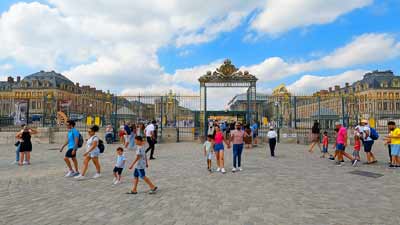
If we use numbers, the geographical position of the palace is as follows: 17.1 kilometres southwest of the heart of Paris. Why not Paris, you ask?
The fact is that it was this city-commune in the years 1666-1789 that was the main seat of the external royal court. Yes, yes, a kind of quiet “villa”, which Louis XIV furnished on a simply royal scale.
Who built the Palace of Versailles?
There is a stubborn misconception that Versailles was founded by Louis XIV. In fact, the Sun King only completed and “drowned in luxury” what was founded by Louis the XIII, nicknamed “The Just” – the legitimate son of Catherine de Medici and Henry IV.
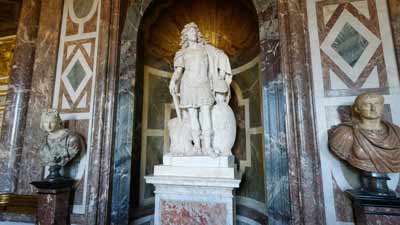
The exact date of the start of construction is also known: 1623. Then, on the family lands of Jean de Soisy (who sold his possessions to the king), a hunting castle first appeared – a modest small (24m x 6m) brick house, lined with slate and wild stone. Now, instead of the hunting castle, there is a Marble Courtyard – a huge square paved with natural marble tiles polished to glass. The drawing of the yard is black and white geometric.

Nine years later, Louis the Just, who decided to arrange country apartments, bought the Versailles estate from Archbishop Jean-François de Gondi and began a two-year reconstruction of his not too large castle.
By the way, the eastern facade of the Chalet is precisely the “stamp of the style” of Louis XIII: he adored a kind of fusion – a mixture of early French classicism, Renaissance and Gothic. He also rebuilt the “porcelain pavilion” lined with faience tiles. Imitating the then famous Northern European Delft faience, the designer of Louis XIII painted the entire surface of the walls in cobalt blue. From 1688 the Grand Trianon replaced the porcelain pavilion.
The life of Louis XIV
When he first saw the hunting palace the Sun King immediately decided to get rid of the modesty of the interior and exterior. It was on his initiative that a grandiose reconstruction of the legacy of Louis XIII began.
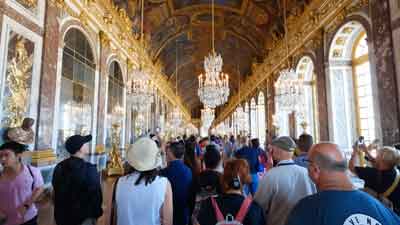
Unlike his predecessor, the Sun King preferred the “Classicist” style. They say that the king’s monstrous zeal for the excessive, downright blatant luxury of the palace, is associated with envy. Yes, one day Louis saw how N. Fouquet, his finance minister lived. After which Fouquet, who constantly abused the king’s trust was arrested and his artists and the architect of the palace, Vaux-le-Viscount, were hired by the king for his own needs.
What is it like, the Palace of Versailles?
Actually, this is not one palace, but a complex of several! It’s not for nothing that this most popular place in world tourism is called the official word “ensemble”:
-
Chateau — a palace itself;
-
a museum “pair” consisting of the Grand and Petit Trianon;
-
Estate of Marie Antoinette.
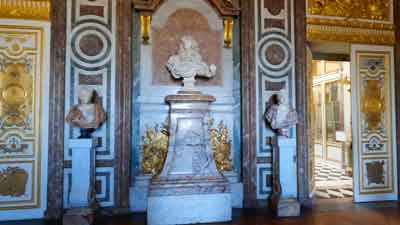
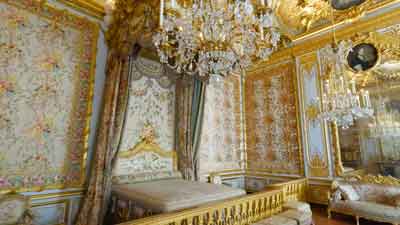
The main beauty, of course is in the Chateau: here every centimetre of surface – from floor to ceiling – is decorated with paintings, carvings, Venetian glass, frescoes, gilding and other attributes of wealth. There are a total of 3,500 rooms isolated from each other. Don’t be surprised by the strange names of the halls and salons: they were named after the Greek gods. Of course, the name of Louis’ own throne room is Apollo, the sun god.
The intended purpose of the premises was lavish balls, feasts and other types of riotous pastimes for the king and nobles. Separate rooms are also provided for sleeping for the nobility and for receiving delegations.
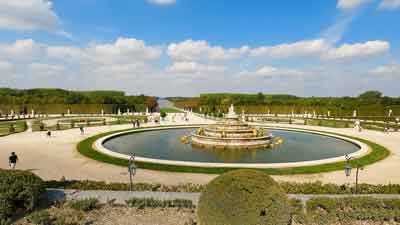
Well, all the buildings are surrounded by a giant park and wonderful gardens. They were laid out on the adjacent territory (former swamps, which were drained at the behest of the king) measuring 800 hectares.

TOP 7 interesting details about Versailles
-
This is a recognized symbol of the system of absolute monarchy – a specific form of government that transfers all power for the sole disposal of the king.
-
The famous peace treaty was signed at the Palace of Versailles in 1919 returning Alsace and Lorraine to France. The document put an end to the confrontation between Germany and the anti-German coalition, marking the end of the First World War.
-
Louis XIV moved his official residence from the Louvre to Versailles for personal safety, making the new palace the political centre of France.
-
Six thousand courtiers lived in the palace permanently: they were forbidden to leave this place under pain of deprivation of privileges and positions.
-
Such a paradox of fate: it is believed that the 50-year construction of the residence, which cost the treasury a gigantic sum of 260,000,000,000 euros, caused the fall of the monarchy 100 years later. But another 150 years passed and the Palace of Versailles became a constant and abundant source of national income for the French.
-
Despite the extreme splendour of the architecture, living in the palace was not very comfortable. The fact is that the construction of Versailles, which had already been delayed for 50 years, was forced and also the lack of funds, which had already invested almost 26,000,000 lire (1 lira is equal to 409g of silver) – all together resulted in gaps between the walls, non-working fireplaces and others, “the charms” of poor-quality construction.
-
There are no toilets in the palace! Royalty used the prototype of modern cubicles – they were carried by servants from corridor to corridor.