by

Rosslyn Chapel, Scotland
In the footsteps of the Knights Templar
Rosslyn Chapel gained planetary-scale fame after the release of the film “The Da Vinci Code”. In the movie, as in the book, Rosslyn Chapel was the place where Mary Magdalene found her final resting place. Although the film was released in theatres and on TV in 2006 the historical structure itself has a centuries-old history as it was erected in the suburbs of the city of Edinburgh in the 15th century.
Rosslyn Chapel is a delightful, mystical, gothic monument of history and architecture which today enjoys immense popularity among tourists from all over the world. This is due to two coinciding factors.
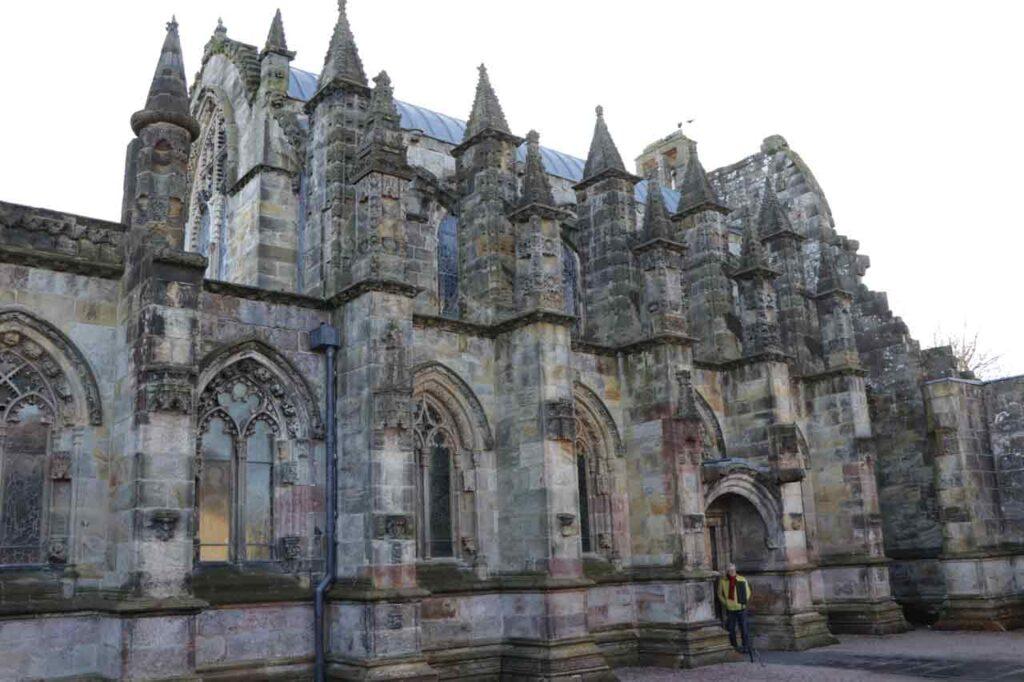

The first is the appearance of the chapel strikes with its fine architectural expressiveness expressed in marvellous carving and decorations.
The second is the numerous legends and mythical tales about the place which arouses the interest of a huge number of people and leads to an endless stream of tourists every year.
Rosslyn Chapel has another name – the Collegiate Church of St Matthew. The structure is located near Rosslyn Castle in the suburbs of Edinburgh, Scotland. According to scientists the reason why the structure is so well preserved is due to the absence of wooden elements in its construction. The entire chapel is erected solely from stone.
History
The history of the chapel spans more than 550 years and began in 1446 when it was founded by Earl William Sinclair. The Earl was the founder of one of Scotland’s oldest clans – the Sinclairs. The chapel would subsequently become a vault for members of the family. When Earl William Sinclair died, construction of the chapel continued under the leadership of his son, Oliver
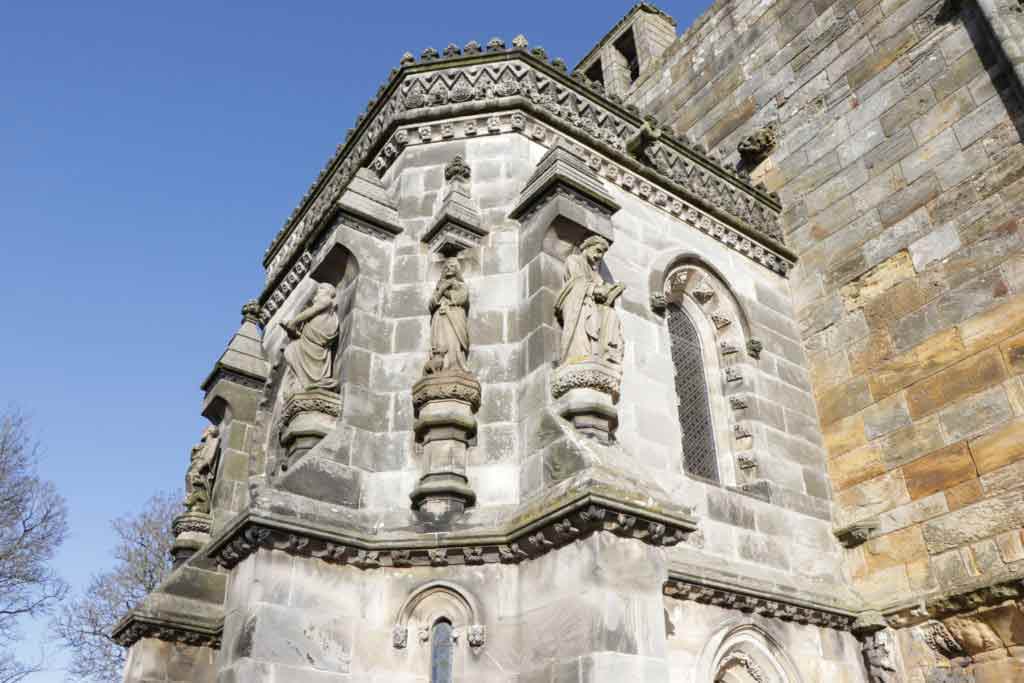
Masses ceased to be held in Rosslyn Chapel after 1650 because the walls were used as a stable by Cromwell’s soldiers. The chapel was also subject to some destruction by local residents who were adherents of the Reformation. They were not able to completely destroy it though and in 1736 it was partially restored by James St. Clair.
The chapel was restored again in 1861 and thanks to this it began to function as a church again too. Sunday masses began to be held here.
Rosslyn Chapel continues to operate today.
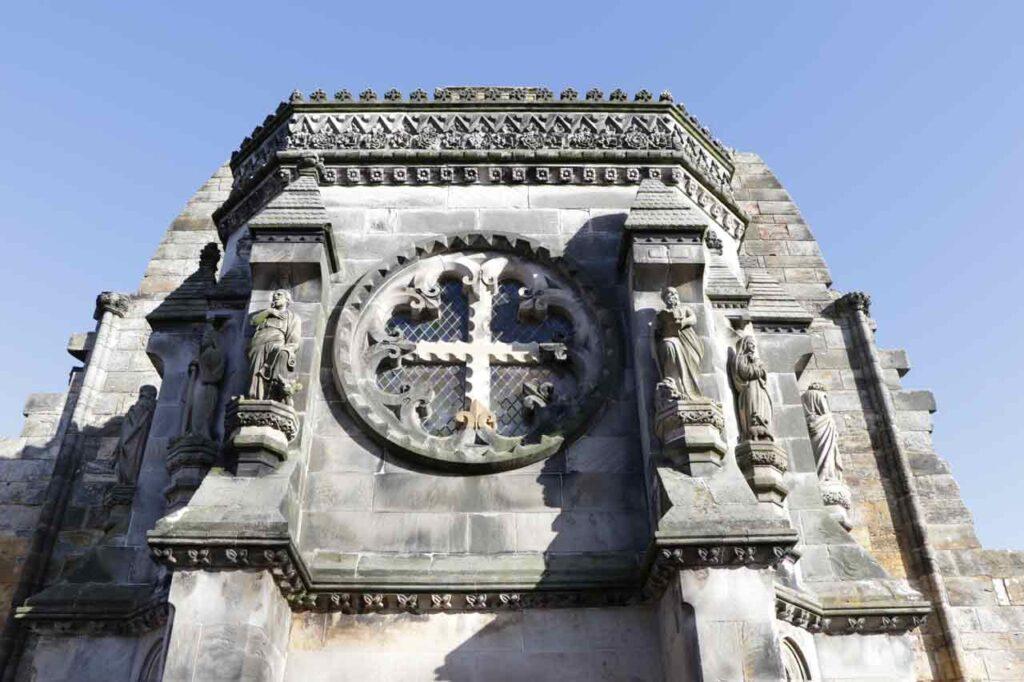
It took approximately 40 years to build the chapel. Another 40 were needed to give it the delightful man-made carving which decorates the interior of the building.
Architecture
Rosslyn Chapel is arguably the most magnificent building in Scotland. To this day, plans for the building have never been found. Therefore nobody knows for sure whether the appearance of the chapel that we see today is what was intended. However, the fact remains that the building was not completed and its original shape was supposed to be in the form of a cross.
From this it becomes clear that only the Choir and the Lady Chapel (also called the Chapel of the Virgin) were built. At the base of the Lady Chapel lies an old crypt (the Lower Chapel) presumably dating back to the old castle. Often the crypt is mistaken for burial dungeons. The Lower Chapel was tightly sealed many years ago and numerous legends come from it.
Rosslyn Chapel is supported from the inside by 14 columns. These support an arcade of 12 arches along three sides of the nave. The columns located on the eastern side of the chapel are named. If you look at them from north to south the names of the structures are: the Master Column, the Journeyman Column and the Apprentice Column.
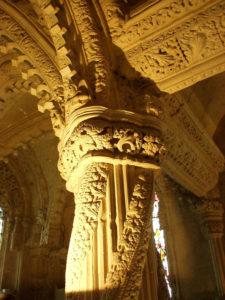


Special attention is deserved for Rosslyn Chapel’s decorative carving which includes the columns, ceilings and walls. The elements in the form of cubes, of which there are 213, never cease to amaze and intrigue. These “boxes” protrude from columns and arches.
The chapel also has its own distinctive symbols – the “green men”. These are faces which are surrounded by the greenery of trees and bushes. These elements are found everywhere and they are especially numerous in the Lady Chapel, located at the eastern centre between the altars.
There are also ornaments of various plants such as wheat, strawberry, lily and others among the reliefs.
An amazing discovery was made not too long ago in 2010. During restoration the roof was dismantled and a chamber in which bees had been bred was found inside. This fact proves the presence of a beehive in that very chamber.
There are many legends, rumours and conjectures surrounding the sacred and mystical place of Rosslyn Chapel and each of them is fascinating and mysterious. One of the most popular legends is the story of the Chief Architect and his apprentice who built the chapel. Both were engaged in the construction of the chapel’s columns however the architect saw that the column built by his apprentice was a hundred times superior in beauty to his own and he killed the poor apprentice out of envy for this.
According to other conjectures, Rosslyn Chapel is the place where the famous Holy Grail chalice is kept. Other tales claim that the crown of rulers of Scotland is hidden here as well as golden treasure which belonged to the Knights Templar. Access to the gold can supposedly be gained through the very mysterious symbols inscribed on the ceiling of the chapel.
There are not a few conjectures surrounding the reliefs depicting corn. The main question is how anyone in 15th-century Scotland could have known about corn, given that America was discovered by Columbus much later. Some believe that America was discovered much earlier and that the Scots took a direct part in it while others think that Henry Sinclair I, who began construction of the chapel, visited America and saw the crop there after which he decorated the building with ears of corn.
Interest in the history of Rosslyn Chapel and in the structure itself grows more and more with each passing year. The delicate lace pattern on the walls and vaults of the chapel stuns the eyes of tourists while stories of mysterious maps, stashes and treasures in the chapel’s dungeons draw numerous seekers of adventure and legends to it.