by
by 
Historical Centre
Edinburgh has been the capital of Scotland for over 500 years. It can be called the “heart” of a proud power and, undoubtedly, the most beautiful city in the region. The city is also the historical and cultural centre of Scotland. There are a huge number of architectural monuments such as museums and ancient castles and various festivals are held all year round.
Tourists will be able to see Edinburgh Castle no matter which direction they enter the city. This majestic building which rises on a high hill, is the hallmark of the capital. There is an exhibition called “Honours of Scotland” within the walls of the castle. The most precious jewels are kept there – the oldest royal jewels in all of Europe.
This exhibition was opened by the world-famous writer Walter Scott. Scott discovered the collection after it had been in oblivion for 111 years. He is a Scottish national hero and is beloved by his countrymen.
On 4 February 1818, the future George IV, acting as Prince Regent, issued a Royal Warrant authorizing historian Walter Scott and a group of officials to demolish the wall of the ancient Crown Chamber. Half of those present expected the oak chest in the room to be empty. They opened it and found a crown, sceptre and sword exactly as it had been left 111 years earlier.


Next, it will be interesting to see the famous “Stone of Destiny”. According to legend, all the rulers of Scotland were crowned there.
Next you will see St. Margaret’s Chapel, which is the oldest building in all of Edinburgh. It was erected in memory of the mother of David I. The observation deck of the chapel offers a wonderful view of the city.


Old Town
The Old Town situated at the foot of the castle, the historical centre of the Scottish capital and listed as a UNESCO World Heritage Site, enchants with its grandeur. You can spend hours wandering through the narrow labyrinth of streets, looking at the ancient grey buildings with sharp spire towers, above which Scotland’s flag flutters proudly. Most of the buildings in the Old Town have been preserved since their construction and are typical examples of mediaeval architecture. Many houses are covered with soot left over from the Middle Ages, when houses were heated with coal and wood, so the predominant colour in the Old Town is grey.
Now, let’s go a little lower down the High Street. Here is the house-museum of John Knox, or as it is also called, the John Knox House, as well as the “Abode of the Rebel”. How long the great rebel and reformer John Knox actually lived in this picturesque four-storey house with an attic is not entirely clear to science. But it is known for certain that he died here. Today, inside this ancient building is a museum which vividly immerses guests in the atmosphere of the 16th century with its interiors and wonderfully painted ceilings (such an unusual fashion reigned in Scotland at that time). By the way, it is said that before this house passed into the hands of this Scottish church reformer, a respected family of jewellers lived in it and they can be credited for many of the details of the museum interior. But the corner under the small arch for kneeling and the stained-glass windows of the saints are the work of John Knox.
John Knox’ house is a place, it should be noted, which is extremely curious and unusual. Firstly, you will see how the Scots lived in the mediaeval era and, secondly, you will learn a lot of interesting things about the personality of the legendary John Knox himself. After all, before visiting Scotland, many foreigners had no idea what kind of person this old man John was…


Holyrood Park and Arthur’s Seat (Arthur’s Seat)
Walking down the Royal Mile, you can get to the place where the royal forest used to be, but which is now the location of Holyrood Palace. This palace is the residence of King Charles III.
The ruins of the Chapel of St. Anthony rise on a hill next to the palace. This is the only building in the central part of Edinburgh’s Holyrood Park. It looks more like the emaciated ruins of an ancient castle than a religious building. It sits on a rocky outcrop above St Margaret’s Loch offering stunning views of northern Edinburgh and the Firth of Forth. Surprisingly little is known about this building, whose construction must have been observed for miles around. Ownership of the land making up Holyrood Park has been shared between Kelso and Holyrood Abbeys since the 1100’s and it is believed that the territory occupied by the chapel belonged to Kelso Abbey. Despite this, it is likely that St Anthony’s Chapel was closely connected with Holyrood Abbey and was only a few hundred yards to the north-west. They were connected by a well-made stone path, now much worn, with noticeable curbs that can be seen in some places.
It has been suggested that the chapel served as a kind of religious beacon and that it was intended to be clearly visible to seafarers arriving at Holyrood Abbey as they sailed up the River Forth. In terms of dating, there are references to a grant paid by the Pope in 1426 to renovate the chapel, suggesting that the building may have been built in the 1300’s or later. The details of its demise are equally unclear, but it appears that, like Holyrood Abbey itself, St Anthony’s Chapel fell into disrepair after the Reformation in 1560.


After exploring the main attractions of the Old Town, you can stop by one of the nearby pubs. There you will be offered the chance to try extremely tasty and very satisfying dishes of Scottish cuisine. Naturally you need to wash all this down with whiskey or local beer. Local pub regulars will be happy to tell you many interesting stories about their city, about the spirits living in ancient castles, about national heroes and many more interesting things.
New Town and Calton Hill
The New Town has a huge number of galleries. The National Gallery contains portraits of all the personalities who have ever glorified Scotland. Once inside the Gallery of Modern Art you can see paintings by world famous artists, for example, Dali, Picasso, Matisse, Miro and many others.
By the way, various festivals are held in Edinburgh almost all year round. So everyone will find something interesting for themselves: be it a festival of cinema, music, books, jazz or science. The Military Tattoo festival is the most popular among foreign tourists. A colourful procession of military bands dressed in national clothes and playing bagpipes is accompanied by fiery national dances. The fun ends with festive fireworks at the foot of Edinburgh Castle.
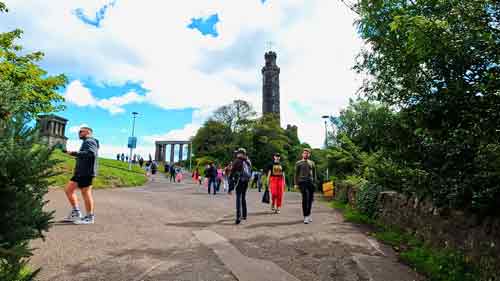
The National Monument in Edinburgh is a clear echo of ancient Greece and a new nickname for the Scottish capital.


This “Parthenon” is quite strange to see in the country of bagpipes and kilts. Well, somehow, the bright antique image of ancient Greece does not fit with the rough morals and strange customs of the “people of the mountains” – the Scots. However, it is a fact. In one of the picturesque corners of Edinburgh there is something similar to a dilapidated Athenian temple. And only later do you find out that this is the famous National Monument, built, but never completed in honour of the fallen Scottish soldiers who participated in the Napoleonic Wars.
It is a little strange and absurd that the authorities simply did not have the money for such a significant project. But that only makes this monument seem more attractive and colourful! Both during the day and evening, at the foot of the National Monument and on its steps, you can see tourists and local residents who have chosen this place to spend leisure time and to contemplate the surrounding panorama.
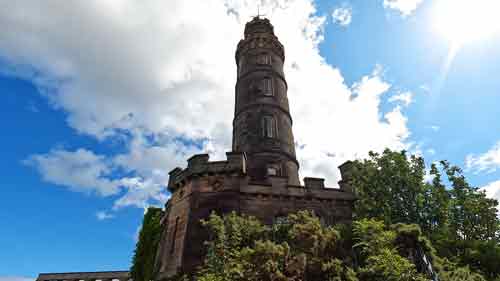
And just a few metres from this unfinished monument to Scottish soldiers is a monument to Admiral Nelson, the hero of the Battle of Trafalgar. By the way, it was precisely for this architectural “incompleteness” of the National Monument on the green hill of Edinburgh that the city began to be called “northern Athens” …