by
by 
Today is a special day because my old dream is about to come true: to see Dirleton Castle live, with my own eyes. I’ve heard a lot about this once majestic 13th-century building. And now, finally, the time has come to examine what remains of it. According to Wikipedia the current state of the castle is in ruins and “destroyed.”

Well, good luck! As always, I will use the regular bus, it is very convenient and on the road you can easily explore the area through which the route to Dirleton passes. By the way, the object of my dreams is located in the locality of the same name – in the village of Dirleton!
This time a comfortable bus takes me in the opposite direction to my last trip in Fife County. It’s not surprising because I’m going to East Lothian and the North Sea lies between it and Fife or rather, part of it, the Firth of Forth.
It’s great that the path is different! I would love to explore the area surrounding the village of Dirleton. It’s new to me. So, let’s go!
The entire journey to Dirleton which is almost 23 miles long from Edinburgh (about 40 kilometres) takes only one hour and 16 minutes. Time somehow flies by unnoticed because I keep looking out of the window at the passing landscape of such settlements as Portobello, Monktonhall, Wallyford, Seton Mines and other incredibly beautiful cities and settlements.
From the beauty I see my already elated mood improves with every mile, reaching a state of delight at the final stop of North Berwick, a small town in the East of Scotland with a population of almost 7,000. Here, in North Berwick, I make a change and the second bus of the day takes me from the southern shore of the Firth of Forth deep into East Lothian, straight to the village of Dirleton. Fortunately, the journey is only three kilometres.
Dirleton village
Would you like me to describe my impressions of the final point of my hour-long journey in one word? “Fabulous!” This is exactly the association that the city or rather the village of Dirleton evokes in me. I am no longer surprised by the meticulously maintained houses and streets of Scotland, but here in Dirleton the atmosphere of antiquity is clearly felt, a sort of aroma of the Middle Ages hanging in the air of the 21st century.
The houses are like toy houses, there is a feeling of celebration and some kind of solemnity. Oh, how I would like to join the locals and stay here forever … but another discovery of today awaits me: the castle.

Walking slowly along the clean streets, breathing in the clean air and feeling the weight of centuries on my skin, I head to 2 Castlemines Place, to the park surrounding the castle. And then a surprise is waiting for me.
Don’t panic, everything can be fixed!
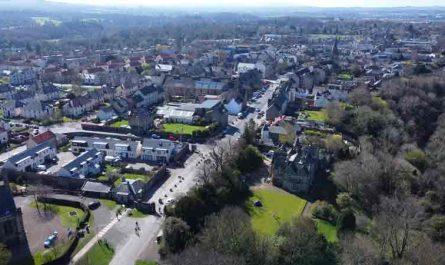
I am going to fly my quadcopter over the castle and the surrounding area. I often do this because the panorama which opens up from a low bird’s eye view allows me to get a good look at what’s below.
But I am in for disappointment. Coming close to the entrance to the closed territory of the park (it is fenced off as a state-protected cultural heritage), I unexpectedly see a sign with a couple of words that causes me a moment of confusion and reads “No drones.” This means one thing – you cannot fly drones over a protected area.
Well, I am not going to violate the administrative ban. My confusion lasts for less than a minute and soon I launch my trusty quadcopter 10 metres from the territory prohibited for drones. And I am right: the incredible beauty that is revealed from the height of the quadcopter soaring into the sky is enough!


See for yourself how nice it is down there, eh. I feel like I’ll have a good dream about Dirleton today. At least the pleasant impressions of the breathtaking view from above will last for a week, that’s for sure.
If this area looks so gorgeous from above and from the side, then what impression will it make on me when I walk inside? Let’s see.

Dirleton grounds
The territory of Dirleton Castle enclosed by a solid fence is quite large – there is a picturesque park-garden, a dovecote and the castle itself.

By the way, the dimensions of the castle are modest: 40 by 28 metres. It was technically possible to build something and thereby increase the area due to the location of the castle on a natural hill on rock. A moat has been dug in front of the castle which is completely natural for most castles. With its width, medieval builders did not become modest – they dug out by as much as 15 metres!


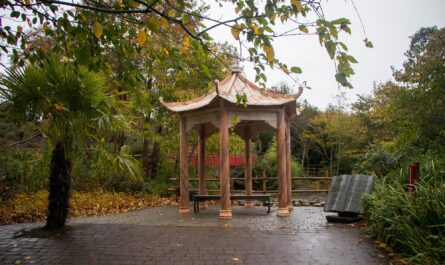
The castle itself is located almost in the centre of a large garden. This is the former agricultural land of the Dirleton barons. They say that the garden park laid out in the 16th century now looks completely different than it did 800 years ago, but look how beautiful it is! In season there are many flowering plants (almost all of them replanted in the 20th century), exuding a spicy aroma and the large lilac-pink thistle buds are especially interesting.
And here’s another thing. In 1911, on the day of the solemn coronation of George V, James Law planted for Mrs. Nisbet Hamilton Ogilvy a tree in the garden, the species of which is impossible to guess (at least to me, not being the least bit a botanist).
Dirleton Castle
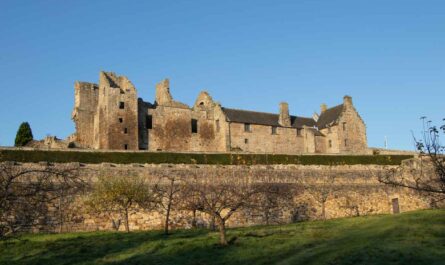
So, now, having a good time walking around the sun-drenched park, it’s time to take a look at this dilapidated monument of Scotland’s historical past! It is open every day to visitors from 9.30 am to 17.30 pm.
Experts say that the oldest parts of the castle were built in the 13th century. The purpose was to guard the coastal route from England to Edinburgh, Scotland which passes through the port of North Berwick.
You can almost feel the Middle Ages under your skin here when you look at the stone walls damaged by time and man and when you go inside. The weight of time just falls heavily on your shoulders!


Look how ancient it is! It’s gloomy, creepy, but exciting! Vaulted ceilings that look like large chimneys and large arched windows – we readily imagine members of the family of the knight, Sir John de Vaux, who began construction of the castle in 1240, walking along the dark corridors and chambers as well as two other noble families:
-
the Halliburtons, who owned Dirleton for 150 years (Lord Dirleton had no male heirs, but his daughter married Sir John Halliburton, receiving a castle without a title as a dowry. Halliburton died in 1355 at the Battle of Nisbet).
-
The Raswins (in 1520, Janet Haliburton, Lady Dirleton, married William Raswin who, inherited the title of Lord Raswin eight years later).
I wouldn’t even be surprised if you meet ghosts here at night. This ruined castle is very atmospheric. On my next visit I’ll have to ask the locals about the legends – they’ll probably tell you something about ghosts and other mysticism.


By the way, I regret that the castle was used so little for its intended purpose – by the end of the 17th century (it was 1650 to be precise) it became completely uninhabited. Until this time Dirleton had “suffered” many trials.
Thus, during the turbulent period at the beginning of the 14th century when there were the wars of independence between Scotland and England, the castle constantly “changed” owners. In addition, military battles associated with the storming of the castle led to the partial destruction of the stone walls.
Of course, the owners tried their best to reconstruct Dirleton. The last of the three owners, the Rasvens, “paid” for their protests against the Scottish monarchy when King James I of England and Scotland confiscated the castle. This happened in 1600.
Since that year very sad times have come to Dirleton – throughout the English Revolution a gang of marauders carried out outrages here, so much so that Oliver Cromwell was forced to besiege the castle, to which guns and stone-breaking tools did not add beauty, but quite the opposite…
The Nisbets (descendants of Lord Dirleton) had no choice but to take care of the famous gardens of the castle and there was no talk of restoring it.
In 1923 the completely neglected ruins and gardens of Dirleton were transferred into the care of the state as historical heritage.
What has survived to this day? Here are the ruins of the 13th century. The house had a pompous facade added to it in the 17th century by the Rasvens: Lady Dorothea and her 15 children lived in the house.
But of the extensions made by the Halliburton family in the fourteenth and fifteenth centuries, only the foundation remains. By some miracle, the clearly visible outlines of a gigantic hall and a once residential tower on the eastern side were preserved. Of the other 16th-century buildings that stood in the courtyard, only the dovecote has survived.
I had a walk filled with emotion and vivid imagination. Oh, how I wish I could wander around Dirleton one more time! I’ll definitely be back, I promise.