by
by 
NEIDPATH CASTLE
… Now these are simply state-protected ancient ruins – categorized as a listed building (buildings included in the cultural heritage list), but 759 years ago Neidpath Castle towered majestically above Peebles. This fishing town, built on the Scottish border with England, was chosen by the owner of the fortress not by chance: it has very picturesque scenery around the completely unchanged Tweed River and is in an advantageous location on the Anglo-Scottish border.
Destroyed by time and people the castle became an integral part of the chronicle of Peebles, its landmark. This is the very artifact that brings the atmosphere of the Middle Ages to any city – no matter how modern and prosperous it may be.
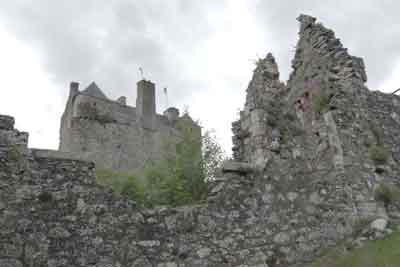
But first things first! It is more logical to talk about Neidpath “from afar” – that is, first devote a few words to the place where the history of the fortress originated and only then pay attention to NEIDPATH CASTLE itself.
Peebles: festivals, an ancient castle and status as Scotland’s best independent retail town
NEIDPATH CASTLE was built in picturesque Peebles, a perfectly preserved town in the 21st century. It was founded by David I, King of Scotland, in 1152. He strengthened and centralized power, minted the first Scottish national coin, borrowed the feudal system from the Normans and adopted the Leges inter Brettos et Scottos code of laws. By the way, it was David I who introduced the system of burghs – self-governing communities endowed with the right of legal entities.

In the past, this ancient settlement was given two sets of status at once: royal city and market town.
However, even today, Peebles is considered the most successful and independent retail centre in Scotland. This is the second city in the UK which surprises with the number of shops and high level of service in them!
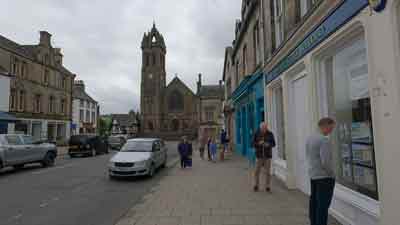
The neighbourhoods, streets and alleys breathe antiquity and will take your breath away from the never-dying Middle Ages. You can start your acquaintance with Peebles by walking along the High Street if you want to look at the handicrafts of generations or walk along the Tweed River if you are attracted by the majestic nature of those places.
Official symbols
The official coat of arms of any settlement contains its “soul”. Here is Peebles’: “Contra Nando Incrementum.” This Latin phrase literally translates to “swimming against the current means growing.”
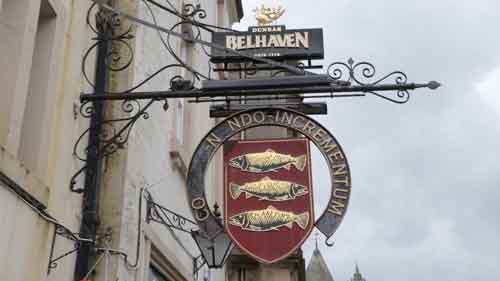
It is noteworthy that this proud slogan is written on the Peebles coat of arms directly under its eloquent emblem and is composed of images symbolic of the royal fishing town:
-
three pink salmon, two facing backward and one facing forward.
-
an antique “crown” of golden maple leaves and cones.
-
a background in the form of a red shield.
The heraldic image is very similar to the coat of arms of the Swedish city of Angermanland only it has a blue background. This is a very old coat of arms, at least 700 years old! The Scottish coat of arms has changed over such a long period of time, its main colour has changed. Previously, the “shield” was blue and then green. Finally in 1894, Peebles’ power settled on red: it was approved along with the provision of arms to the city by Lord Lyon. To this end, William Buchan (the city clerk) sent a petition to the British heraldry expert Arthur Charles Fox-Davies.

However, 89 years later, Peebles no longer had a legislative need for weapons: in 1875 the Scottish burghs abolished the independent administrative unit (municipal corporation) which had existed in Scotland since the 12th century. However, another 13 years later, the weapon finally returned to Peebles as a city with royal status. This glorious tradition, shrouded in the spirit of the Middle Ages, is still alive.
Peebles’ riches
If you know the history of the city, it becomes clear that the “picture” on the coat of arms and the words written there complement each other harmoniously! The fact is that Peebles, founded by royal decree (Charter), is located among the Border hills, at the “point” of the confluence of the Tweed and Eddleston Water rivers (the so-called “Cuddy”). The town is therefore located in an area of outstanding natural beauty – right on the banks of a salmon-rich river.
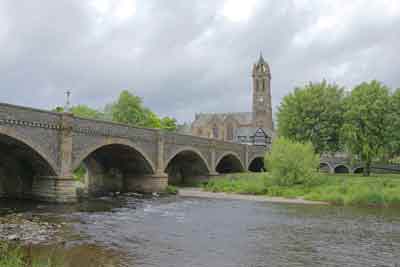
Today, as hundreds of years ago, the fat red fish migrate once a year up the Tweed, obeying the laws of spawning. The fish depicted on the coat of arms and facing in different directions mean they have achieved a natural feat: each salmon that rises up the river is replaced by two that return back to the sea! This is the sacred meaning of “CONTRA NANDO INCREMENTUM”: the river gives Peebles wealth due to the abundance of delicious fish found in it.

Absolutely every guest visiting this charming place will be delighted with its generosity! Fishermen will be able to enjoy the wonderful bite of salmon shiny with fat, cyclists will be able to enjoy perfectly smooth paths, golf lovers will get a boost from a round of golf and those who crave excellent shopping will leave a decent amount of money for luxury goods in numerous boutiques and shops. Those who prefer very aristocratic types of recreation will not lose out either. Recreation includes:
-
horse riding.
-
shops with collectibles and vintage items.
-
Michelin-star restaurants.
Finally, it’s worth coming here for intangible things because Peebles is a small concentration of the cultural life of Europe!
Peebles – City of Art
People come here specifically for “cultivation” as well as for the pleasure of getting to know local traditions – both from many years ago and completely new ones. This city, beautiful at any time of the year, is oversaturated with numerous manifestations of art which include:
-
theatres.
-
museums.
-
tournaments.
-
festivals “for every taste” (jazz, bicycles, food, history, art, traditions).
-
urban architecture that preserves the atmosphere of centuries.
There is even the Eastgate Theatre and Arts Centre, which welcomes 240 guests at a time all year round. People come here for the latest in cutting-edge cinema, fine arts, dance, music and crafts!
No matter what month you visit there is always at least one public celebration going on! For example, on the night of 1st May, the city celebrates Beltane, a pagan date shrouded in legends.
Sightseeing enthusiasts will also find something to keep their inquisitive minds occupied! For example, the ancient market cross at the intersection of Eastgate and High Street, the remains of the city wall (corner bastion) and of course, Neidpath. It is in a dilapidated state and is therefore closed to the public.
Specific Features of NEIDPATH CASTLE
It is useless to look for any obvious meaning in the name “Neidpath” or to make a “literal” translation from English: this is the proper name that was assigned to the castle by its first owner. The fortress was erected in the period 1263 – 1266 – no one knows the exact date.
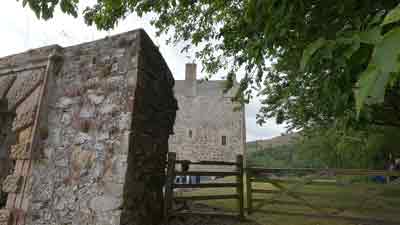
But the history of this citadel in the shape of the Latin “L” is fairly well-known.
Fraser family heirlooms
The architectural landmark of the Scottish Borders (county of Scotland) is historically associated with the Frasers. NEIDPATH CASTLE was first built by the High Sheriff of Tweedale, Sir Gilbert and Simon Fraser was the last to own the property: it was reduced to ashes by the English immediately after Simon’s execution in 1306. So, Mary, the daughter of the brave “Patriot” (a nickname for an amazing feat – a three-time victory over the English in one day in the battles of Roslyn Glen) inherited only charred walls.
Hay era
The “dowryless woman” married Sir William de Hay and the ruined estate became the property of her husband at the beginning of the 14th century. He rebuilt and restored the castle, which had been burned to the ground. It continued to be the favourite residence of the Hay clan even when they took ownership of Esther Castle, converting it into a family estate.
In 1587, a reconciliation between Sir John Stewart and Lord William Hay took place within the walls of the castle. A meeting between warring aristocrats of many years was organized by King James VI who came to Neidpath and summoned J. Stuart from Traquair.
… In December 1650, the castle was evaluated for strength by the army of General Lambert: he attacked Neidpath during Oliver Cromwell’s invasion of Scotland. Alas, the tower built in the 13th century right on the riverbank could not withstand the fierce assault.
From the Earls of Tweedale and the de Hay family to the Douglases
John Hay took care of the castle that withstood Lambert’s siege as best he could: in the 1660s he reconstructed it, erected new outbuildings and even planted a yew alley.
However, all the efforts of the second Earl of Tweeddale were in vain due to a debt of £24,000, which his grandfather left. John Hay was declared bankrupt, which is why he was forced to sell Neidpath in 1686 to the first Duke of Queensberry, William Douglas.
William Douglas transferred the castle to his second son, the first earl of March in 1693 (seven years later). The new owner married the daughter of the bankrupt Marquess of Tweeddale, Lady Jean Hay. The couple had several daughters, one of whom inspired Sir Walter Scott and Thomas Campbell’s poems about the sad “Maid of Neidpath”.
The second Earl of March did a little more for Neidpath: he rebuilt it in the 18th century.
The third Earl of March withdrew from the castle as soon as he inherited the title and estates of the Duke of Queensberry. Neidpath was leased in 1778.
So, the historian and philosopher Adam Ferguson settled within the walls of the castle, having fun there with Sir Walter Scott.
“Bad Times” by the last Douglas owner
The richest farmer William Douglas (the fourth Earl of March) did not care at all about the fortress and its lands which had been well-maintained by previous owners. The fact is that the owner spent all his time in London, performing on stage under the pseudonym “Old Q.”
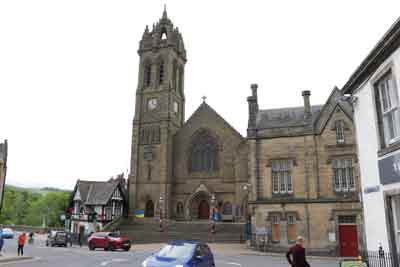
Douglas’s complete indifference turned into outright barbarity in 1795: the earl cut down all the trees and destroyed the delightful hanging gardens which descended along the gentle bank to the Tweed.
Such extravagance was sharply condemned by society. In particular, Douglas was humiliated by the indignant poet William Wordsworth who arrived at the desecrated castle in 1803 with an angry sonnet.
The age of Wemyss’ dominion
The fourth Earl of March (who was fond of theatre) never married and therefore died childless. His inheritance, along with the title, was taken by Francis Charteris, 6th Earl of Wemyss in 1810. His great-great-grandmother, Anne Douglas, was the only daughter of the 1st Duke of Queensberry. A. Douglas inherited Neidpath estate on her marriage to David, 3rd Earl of Wemyss.