by
by 
DELVE INTO HISTORY – MARY STUART, SCOTLAND
Dunbar Castle
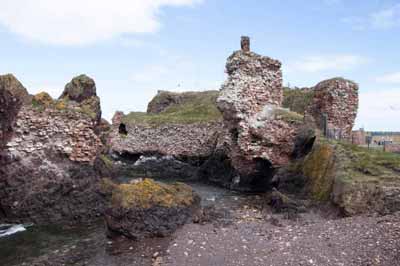
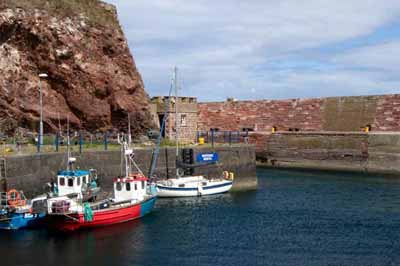
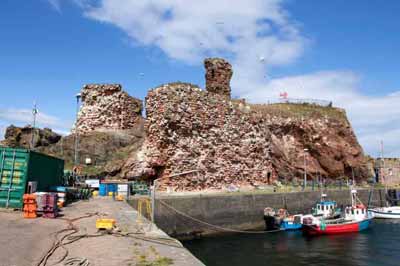
Dunbar Castle is a unique ancient structure of the 13th century which was once an important defensive Scottish fortress used to oppose England. Today only ruins remain which stretch over the port of Dunbar in a picturesque location in the region of East Lothian. Dunbar Castle was destroyed in the 19th century to build a harbour. However a large number of tourists and guests visit this historical place today.
An ancient Celtic tribe called the Votadini inhabited the territory on which the fortress is located. They founded the kingdom of Gododdin here in the 5th century. The name Dunbar originates from the British language.
Dunbar Castle towered over the sea by the 7th century. It was of great strategic importance at a time when the Anglo-Saxon kingdom of Berwick was formed on the territory where southeastern Scotland and northeastern England are located today. Dunbar Fortress belonged to the royal vassals from Northumbria during the Middle Ages. When the king of Northumbia expelled Saint Wilfrid, Archbishop of York, the castle walls served as his prison. The fortress was completely burned down in the 9th century by the Scottish king, Kenneth I
Count Gospatrick (one of the last in Northumbia) laid the first stone of the building of the fortress in about 1070. This was taken from Dunbar Castle. The castle came to him from the Scottish king, Malcolm III who presented the territory to the king as a gift when Saint Patrick escaped from England and needed refuge.
The earls of Dunbar have owned the castle for several centuries. In 1457 the fortress was destroyed again so that the English would not take possession of it.
King James IV of Scotland restored the building in the 16th century and handed it over to the Duke of Albany. Dunbar Castle was burned down by the Earl of Shrewsbury. The French garrison was located in the fortress during the wars between Scotland and England in the 60’s of the 16th century (after restoration). The building was destroyed at the end of 1567 by decree of the Scottish Parliament after the defeat at the Battle of Carberry Hill.
Dunbar Castle under Mary Stuart
Dunbar Castle has belonged to the royal dynasty of the Stuarts since 1433. Maria de Guise, mother of Mary Stuart expanded the boundaries of the fortress in the period from 1550 to 1560. The life of Mary Stuart, Queen of Scots, is closely linked to the history of Dunbar Fortress. Certain events in the life of the young queen brought her to these surroundings. On 11 March 1566 Maria appeared within the walls of the castle after she was forced to flee there, having travelled on horseback for five hours. The event that provoked her escape was the assassination of Rizzio in Holyrood Palace organised by Mary’s husband, Lord Darnley and executed by the lords of the congregation. At this point Mary was carrying the son of Lord Darnley who in the future became James VI of Scotland. Lord Darnley, having asked his wife’s forgiveness fled as he was afraid of the consequences of his treacherous actions towards the lords. Mary Stewart rallied her supporters in Dunbar and a week after these events returned to Edinburgh after the assassins had already fled to England, seeking refuge there.
Mary returned to the castle again in the fall of 1566. Bothwell brought Mary into the walls of the fortress after allegedly kidnapping her on 24 April 1567 while she was returning to Stirling to see her son. It is believed that it was at Dunbar Castle where Mary was put into a position whereby Bothwell forced her to agree to marry him since only this could save her honour. Mary and Bothwell were married on 15 May at Holyrood House in Edinburgh.
Queen Mary’s sympathizers said that Bothwell, who instigated the assassination of Lord Darnley, was thirsty for power and that he raped the weakened queen. His main goal was to exalt himself above nobility.
However, those who scolded Mary agreed that a deal had been struck between Mary and Bothwell in which a rape story was invented in order to hide the connection between the young queen and the one who killed her husband.
However, the true reasons for those events were most likely in the middle. In letters found in a box which were usually recognized as fake, a marriage contract was discovered, which was signed by Mary on 5 April 1567. Other letters that Mary wrote to Bothwell after he told her that he wanted to kidnap and marry her are said to have been the best way for Mary to restore her weakened position. Since Mary’s forces at that time were weak she agreed to the proposal of a man who had been faithful to Mary’s mother and herself all his life while also holding power in Scotland.
The nobles from Scotland who had initially supported the marriage of Mary and Bothwell soon changed their minds and signed a bond according to which Bothwell was to be overthrown. Mary and Bothwell fled from Borthwick Castle, but were soon surrounded and returned to Dunbar Keep. They staged an uprising of troops against the nobles on Carberry Hill on 15 June 1567. However the result of the uprising was not Mary’s victory, but her surrender which was followed by imprisonment in Lochleven Castle where she spent almost a year of her life. Bothwell, surviving the day of the uprising, fled back to Dunbar Castle. He received no support in the affair with Mary and was forced to go to Orkney. Years later he died in prison in Denmark.
Dunbar Castle today
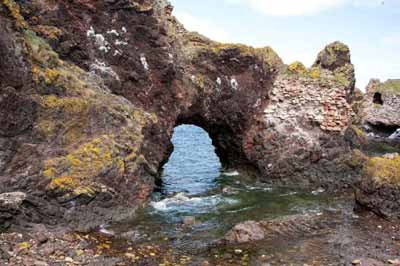
Today ruins stand on the sheer cliff where the majestic octagonal Dunbar Castle once stood. However even in the remains of the building you can see part of the walls and the gates that lead to the main rooms of the castle. On the gate you can see the coats of arms of the 14th century – a triangular coat of arms depicting a lion standing on its hind legs with a border of eight roses. On the right side of it are the Bruce coats of arms, on the left side are the coats of arms of the Isle of Man.
Several towers stand so low that they seem to be lined up along the edge of the sea. To the northeast of Dunbar Castle is a large cave. It was part of the prison which held the famous Scottish poet Gavin Douglas in 1515 – Gavin Douglas, Bishop of Dunkeld.
From here there is a passage which leads directly to the bay. It is believed that it was through him that Sir Alexander Ramsey got into the castle carrying supplies during the time the fortress was besieged in 1338.
The premises located in the northwestern part of the castle belonged to Mary Stuart, Queen of Scots.