by
by Culross
Very little time has passed since my last trip, but the thirst for new travel to the corners of Scotland which are unknown to me has returned again. So, where to go this time?
I open the map and as usual look at the coastline of my favourite Firth of Forth – over the past few months I have discovered so many interesting towns and villages here!
Hmm, what kind of Culross is this? Very interesting, it sounds like a male Spanish name.
That’s it, it’s decided: this is where I’ll go today and along the way I’ll read some facts about Culross.
Let’s hit the road!
The beginning of my new voyage is the same as it was last time: I arrive in Dunfermline and board a regular bus. By the way, there is a “direct” train to the place I am visiting today – from Dunfermline station to Culross station there are only two intermediate stops.
But I get on the bus deliberately because it gives me a better view of the settlements through which the bus travels.
And here I am sitting on a comfortable seat on the bus which is taking me to Culross. As always, I have a smile on my face: I can’t help it, there is a breathtaking view from my window.
After about half an hour of pleasure from the trip I’m in Culross. As soon as I get off the bus a very unusual feeling befalls me when looking at the wilderness: it is as if I have found myself in the pages of one of Charlotte Bronte’s books such as Jane Eyre or Thornfield Hall.
Well, hello village! You are very atmospheric at first glance. I don’t know how to explain it: you have to see it with your own eyes and feel it with your heart…
Walking around Culross and enjoying the views
It turns out that the name that intrigued me this morning is not a Spanish male name at all, but a specific object, translated from native Gaelic, Culross is a cape (or a sharp point, as you like!).

Once upon a time, or more precisely up until 1975, the village bore the honorary status of a royal burgh, a settlement located on the land of a king which had the privilege of a monopoly on foreign trade.

But in the past it was not just a burgh, but a port city bustling with life!


By the 18th century, the functioning of the port began to subside and during the era of Queen Victoria it ceased completely. In the second half of the last century, due to the construction of the railway line, the harbour was filled up which cut off direct access to the North Sea. Active trade ended and with it vibrant city life. These were difficult times for Culross: it became a ghost town.
Fortunately, a local village group restored the outer harbour a few years ago and you can now stroll safely into the lead-blue waters of the Firth of Forth.
Today the village looks like a “sleeping kingdom” which is typical of these places: uncrowded, beautiful and peaceful.
But enough history! Do you see the blatant beauty around you? I don’t know about you, my dear viewers, but some kind of reboot of my aesthetic perception occurred: I discovered that I especially like the flair of the Middle Ages which is concentrated here in a small village with an area of only a few tens of square kilometres!
Look at these well-kept buildings, the quaint architecture of which immediately reveals the weight of centuries! Some houses are a hundred, two hundred, three hundred or more years old! But they stand like tangible ghosts from the past and the thick spirit of bygone eras hovers in the air. Do you see how many red roofs there are? No, this is not the historical legacy of the large-scale production of red tiles, which the medieval and modern inhabitants of Culross gladly laid on their roofs, the tiles were delivered here by ships returning from Holland (they took coal to Holland). At the same time, the tiles were not some kind of valuable commodity, but were thrown into the empty holds as ballast giving stability to the ship.
Apart from the pretty tiled roofs, there is a lot to see here, that’s for sure. The village began to be developed intensively in the 16th and17th centuries, in 1575 the enterprising Sir George Bruce built a coal mine in Culross and in 1595 he built a Moat. This is how the world’s first mine laid under water appeared and Culross turned into a centre for coal mining and processing.
By the way, the mines of Sir George Bruce were technically very cleverly equipped! So much so that the Culross mine is generally considered a man-made miracle of the British Isles of the 17th century.
Coal was the most important type of fuel at that time and therefore investments flowed into the settlement.
It is a pity that it is not possible to look at this miracle, the Level Pit was completely destroyed by a strong storm which hit the shore of the village on 30 March 1625.
Did you know that this beautiful and original “sleepy kingdom” has become the stage for quite a large number of films and very famous ones? How do you like names like:
-
“The Little Vampire” (filmed in 2000).
-
the television series “Stranger” (released in August 2014).
-
“Captain America: The First Avenger (appeared on screens in 2011).
-
“Kidnapped” (released in 1971).
-
“39 Steps” (2008).
-
“A Dying Breed” (2007).
When I get home, I’ll definitely watch one of them so I can see this cute village as a stage set once again!
Of course, I went straight to the most interesting building of Culross – its palace! It was built by the same well-known Sir George Bruce of Carnock, who donated the mine to the city.
Here it is, this merchant house with a gable roof and a stepped gable.

A few yards from the palace is the Tolbooth or Town House, with its distinctive tower steps leading to the ground floor entrance. The town house was built in 1626, but the tower and front façade were not added until 1783. The building originally served as a prison and courthouse. Visitors can see the prison cell and the panelled courtroom. According to tradition common criminals were kept in a prison cell, while witches were kept in the attic. But unfortunately, today was the day when tickets for the excursion were all sold out and I didn’t get there, but I’m not discouraged. I’ll go for a walk up the mountain where another attraction is located – the Abbey.
It is located on a steep slope and offers magnificent views of the surrounding area. It’s about a third of a mile walk from the village centre and an elevation gain of 50 metres. This is a beautiful tranquil place, where there is no rest from the singing of birds, its broken stone walls are beautifully complemented by a soft carpet of grass. Above, a huge old plane tree arches gracefully, which at the end of April bursts into leaf and at its feet the bluebells nod their thin heads.
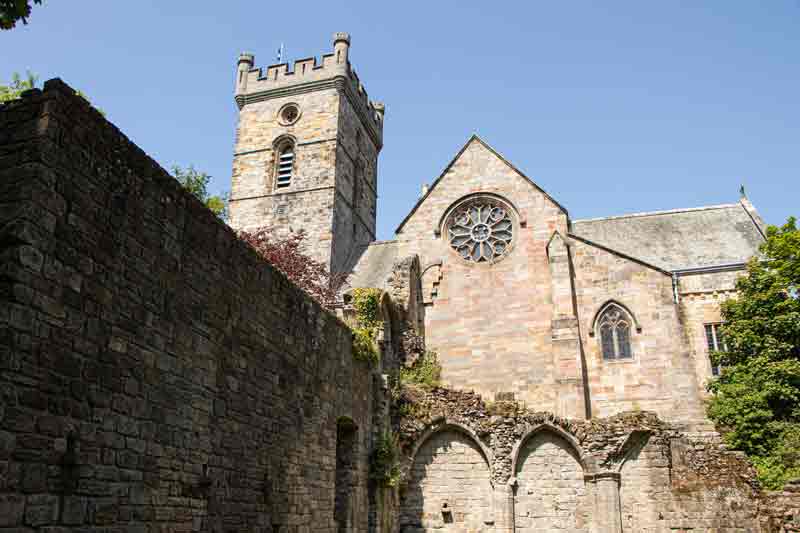
Here it is – Culross Abbey. It has a long and rather complex history and for this you need to dive into the 6th century.
Culross Abbey
From the few information sources that I could find on the internet, I learned that Culross is very, very old! Of course, the first settlement here appeared in the 6th century AD. The founder of the village was a certain Serban (aka Saint-Cerf), a Holy Serf who was highly revered in West Fife. Getting acquainted with the biography of Saint-Cerf I realized two things:
-
he was an outstanding man (of royal origin, by the way!).
-
the person of the saint is “shrouded” in numerous legends.
As the most popular belief relates, Saint Serf was a very kind man and took a direct, fatherly part in the fate of Mungo or Saint Kentigern, the most famous missionary of the early Middle Ages and the official patron saint of Glasgow.
So Saint-Cerf met Teneu in Culross who gave birth to Mungo. The unfortunate British princess, who was also later canonized and recognized as a saint, was expelled from her home by her father, King Lothian. The offence committed by the princess was serious, she was an unmarried girl who was pregnant.

By the way, I softened the story a little: Teneu was not only expelled by her family, but thrown off a cliff. A miracle saved the future saint from inevitable death – she fell unharmed into the water and soon a boat appeared in front of her, steering itself. Needless to say, the self-driving boat sailed across the Firth of Forth straight to Culross, where she gave birth to Mungo.
According to legend, Mungo and his mother were taken into the care of the holy Serf, who preached to the Picts in the area. Mungo was thus raised to worship and he is associated with many places, including the magnificent medieval cathedral in Glasgow. There may well have been a 6th-century monastery dedicated to Mungo here on the shores of the Fort at Culross. No trace of this remains, but it has been suggested that this was the reason why Malcolm, 3rd Earl of Fife chose this site to found a Cistercian monastery in 1217.
The layout of the monastery would have been quite traditional with a church and rows of buildings housing a dormitory, refectory and kitchen. The southern wall of the church was incorporated into the monastery. This must have been a difficult site to build on as it slopes quite steeply down to the sea.
Sometime in the late 1400s, the monks’ focus shifted away from community participation and more toward the purity of worship. The tradition of lay brothers who did much manual labour in farming, carpentry and blacksmithing declined. This appears to be a general reflection of changes in the Cistercian order at the time. Churches have always been divided into two parts: the nave (in the west) and the choir (in the east). The lay brothers sat in the nave and the monks worshipped in the choir. With the departure of the lay brothers there was no need for a nave and so it was demolished at Culross. An impressive 84-foot tower was built and beneath it the new west door included some of the original carvings from an earlier entrance.
Having walked around the abbey to my heart’s content, I go down again to the coast. I’ll go to another attraction of this area, Dunimarle Castle. Unfortunately, I didn’t manage to get into the attraction itself, it was too late, but walking through the park itself was a pleasure.


The castle itself is located on a hill overlooking the Firth of Forth. The landscaping is designed to contrast with the scenic effects. This is achieved by the formal, stately approach to the Castle from the land side and from the sea side views of the Castle directly opposite the Fort, with a sweeping panoramic backdrop of the Lothian coastline.