by
Seacliff Beach in East Lothian is one of the most picturesque and quiet spots on the Scottish coast. It is hidden from busy roads behind a private entrance with an automatic barrier. A small paid parking area where a nominal fee is charged lies nearby. The beach is often called one of the best “secret” corners of the region because of its secluded location.
A short woodland path leads down from the car park to the shore. A wide sandy bay opens up suddenly through the trees with clean water, soft golden sand and rugged cliffs at its edges. On a clear day the landscape resembles the remote Hebrides yet, on the horizon, the main local landmark is clearly visible – Bass Rock which rises above the waters of the Firth of Forth.

Seacliff is ideal for leisurely walks, picnics by the water’s edge and wildlife watching. Children can explore rock pools and search for small crabs while bird watchers can spend hours observing the seabirds that nest on the cliffs and nearby islands – gannets, eider ducks, razorbills and black-throated divers can be seen here. Ancient ruins, an unusual harbour and memorable sites each connected to the history of East Lothian lie not far from the beach.


Seacliff Harbour
On the western side of the bay, within a red sandstone mass at Gigan Rock, lies the miniature Seacliff Harbour. Officially bearing the name it is nonetheless often referred to in guidebooks as the Victorian harbour, having been constructed in the late 19th century.

The harbour is considered to be one of the smallest in Great Britain. Its length is about 12 metres with a narrow sea entrance of roughly two metres. Workers hewed the harbour directly into the solid rock using a steam engine and compressed air equipment by order of estate owner Andrew Laidlay in 1890.


The structure is well protected from the sea despite its small size. Water does not drain completely from the harbour at low tide due to its isolated layout while at high tide its depth can reach up to six metres. Small fishing boats moored here in the past whereas today the quiet stone cove is most frequently occupied by a local crabber’s boat secured by a sophisticated system of counterweights. Even today, this engineering solution looks unusual and sparks the curiosity of beach visitors.


Auldhame Castle
The ruins of Auldhame Castle are hidden among greenery near the old road leading to the beach through trees. This is a small 16th-century castle built in the shape of a letter L. It is associated with Adam Otterburn who held the position of Lord Provost of Edinburgh.

Over the centuries the castle has survived many upheavals. It was severely damaged during the English Civil War in the 17th century when Oliver Cromwell’s forces invaded Scotland and besieged neighboring Tantallon Castle. Later, at the end of the 18th century, local residents began dismantling Auldhame’s walls for building stone. Today, only fragments of the walls remain of the structure, but even these allow one to imagine what this fortified dwelling was like.

Ancient legends are connected to the area of Auldhame Castle concerning so-called ship breakers. According to legend smugglers tied lanterns to the necks of horses and slowly led them along the cliffs on dark stormy nights. Sailors from afar mistook the moving lights for signals that a vessel was safely at anchor and steered ships towards the dangerous rocks of the Great Carr ridge. Following shipwrecks the looters collected the cargo and the wreckage washed ashore. They say it was precisely these stories that inspired Robert Louis Stevenson to create the novel “The Wrecker”.


Furthermore, during archaeological excavations in adjacent fields, a large-scale burial of hundreds of soldiers from Cromwell’s army who had died during the siege of nearby Tantallon Castle, were discovered.

Seacliff Tower
The remains of Seacliff Tower lie to the east of the beach, on a wind-swept cliff above Carr Rocks – another 16th-century tower. Local residents sometimes call it Sligo’s Lookout.

Today the ruins are heavily damaged. The surviving walls up to three and a half metres high are almost entirely hidden by a dense carpet of ivy. Coastal erosion is gradually washing away the edge of the cliff so that the ancient masonry at the base of the tower is becoming increasingly vulnerable – fragments of old walls can more and more often be seen at the foot of the precipice.

St Baldred’s Cross and Boat Rock
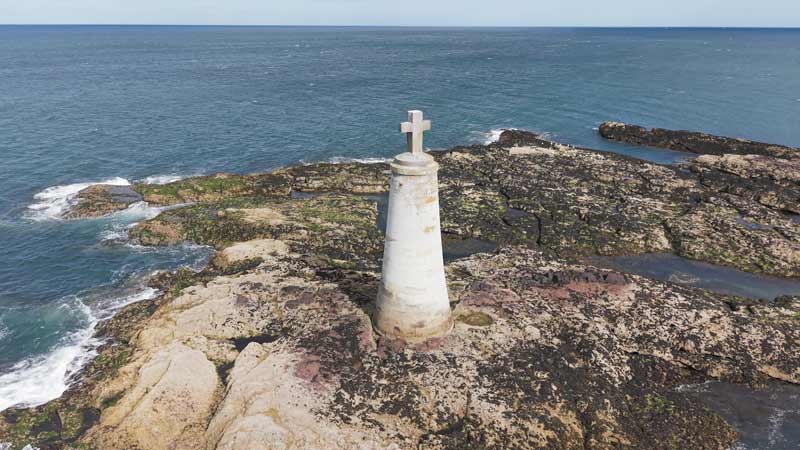
On the eastern side of the coast, a picturesque rocky headland juts out into the sea called St Baldred’s Boat. At the summit stands a conical pillar stone pillar with a cross dedicated to Saint Baldred, an 8th-century hermit who, according to legend, arrived in these parts from Northumbria.

The small Saint Baldred’s Cave lies close to the car park above the beach. Legends state that the saint used it for prayer and seclusion. During archaeological investigations the remains of an ancient stone altar, pottery fragments, artefacts and bones were discovered here. Most of the findings date back to the early Iron Age yet the cave itself still preserves an atmosphere of antiquity, silence and solitude which complements the unique character of the entire coast.
Seacliff House: history and architecture
The ruins of Seacliff House Tower over Seacliff Beach and the Firth of Forth lie within a private estate. Today, only exterior walls, turrets and window openings remain of the mansion, but even without the roof the building retains a sense of its former grandeur and makes a strong impression.
The history of the estate begins in 1790 when Robert Colt built the first house here. This initial building has not survived. The new owner of the estate, George Sligo, invited the famous Scottish architect, David Bryce, to build a grand new mansion in the Scottish baronial style of 1841. The project incorporated parts of the walls of an earlier narrow house which was built around 1750.

Bryce’s preliminary sketches suggest an even more ambitious concept – a high square tower was planned for the north facade, but was never built in the end. Nevertheless the final building turned out to be expressive and became one of the architect’s early examples of work in the Scottish baronial aesthetic. The mansion featured an asymmetrical composition, corbelled turrets (or corbelled projections) and crow-stepped gables.
The layout of the main rooms was also unusual – they faced not the sunny south, but the north. This solution allowed for a panoramic view of the North Sea and Bass Rock. Three main rooms were arranged in steps so that each had a direct view of the coastline. A wide bay window was set in the north corner of the drawing room.

A special role played by the architecture of the estate was a massive screen wall near the mansion. It concealed the impressive coastal landscape from the driveway side and ended with a grand entrance tower featuring gables and round corner turrets. Architectural historians later termed this expressive device the “Seacliff-style entrance”.
Estate owners
George Sligo remained the owner of the estate until the 1850’s. After that, the estate was acquired by John Watson Laidlay – an indigo planter and silk manufacturer who had lived and worked in India for a long time.
Laidlay settled in Seacliff with his family at the end of his business career. He remodelled part of the estate, managed the property and lived here until his death in 1885. His brother, Johnny Laidlay, became famous in the world of sports – he won the Amateur Golf Championship twice, was a runner-up at The Open Golf Championship in 1893 and is considered to be one of the pioneers of using the cross-handed grip which many golfers use today.

The estate was inherited by John Watson Laidlay’s son Andrew after his death. It was he who ordered the construction of the unusual Seacliff Harbour which was carved directly into the rock of Gegan Rock near the beach.
Fire and abandonment
A tragedy occurred on 28 July 1907 when Seacliff House was engulfed by a destructive fire. The fire completely destroyed the interior rooms of the mansion and Andrew Laidlay died. His remains were later found among the ash and ruins.
The famous architect, Robert Lorimer, prepared a large-scale project for the restoration of the estate in 1911, but the work was never started. The house gradually fell into decay – the roof disappeared, the walls began to collapse under the influence of wind and salty sea air and the sandstone masonry became covered in ivy. Just 66 years after its construction the majestic mansion turned into a semi-ruined building without a roof.
Today, surviving exterior walls, turrets and window frames can be viewed from public paths running near the private territory of the estate. A unique time-capsule interior has been preserved in one of the small corner turrets and scratched names and dates left by visitors over various years are visible on its pinkish plastered walls.
Military history and modern times
The estate’s outbuildings were requisitioned by the Royal Navy during the Second World War. A secret research base called HMS Scottish Seacliff operated in this territory to train navigators and it is where anti-submarine defence strategies were developed.
The lands of the Seacliff estate passed into the ownership of the Dale family in the following decades and they continue to farm the surrounding areas. The literary heritage of Robert Louis Stevenson, author of Treasure Island and Kidnapped, is also connected with this place. One of the ancestors of the Dale family was related to the writer and, according to researchers, the nearby island of Fidra may have inspired Stevenson to create certain images and plot details for his classic adventure works.