


 by
by 
Walking around Paris
Do you too, when you hear the word “Paris” immediately and automatically re-play the first verse from Sous le Ciel de Paris performed by Edif Piaf in your head? This is how this seductive city charms you in absentia, persistently inviting you to visit.
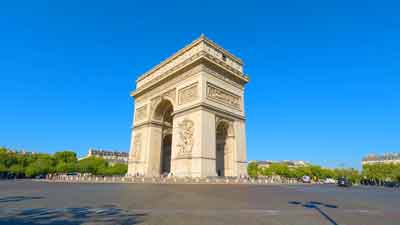
Well, since we are already here, let’s walk through the most iconic places of Paris and enjoy the phenomenal beauty woven from its Gothic architecture, its pure French sophistication and love in all its manifestations which is in the air – this emotion directly electrifies the air of grandiose Paris.
Today, I was able to see with my own eyes, three “points” on my list that were in my notebook as attractions requiring a priority visit:
-
Champs Elysees (we mainly managed to see the upper part).
-
Alma Bridge.
-
George V Street (or Avenue).
Probably a strange selection. But this is an ideal introductory “first day” for a backpacker visiting Paris for the first time in the warmer months.
Champs-Elise or Champs Elysees
Of course, these are not fields as Russians would understand it, but a city street and the most central and very wide: 71 metres in diameter. This is the main thoroughfare of District 8 which is historically home to very wealthy citizens, well roughly so like Arbat or Kutuzovsky in Moscow.
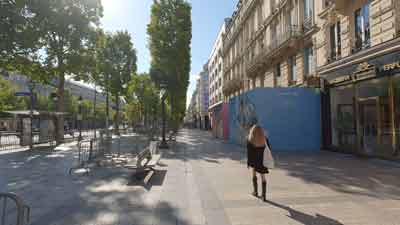
The fields begin with the Luxor Obelisk of the Square of Concord and end with the Arc de Triomphe at Charles de Gaulle Square. The total path from east to west (or vice versa) is 1915 metres which, in principle, is not so much.
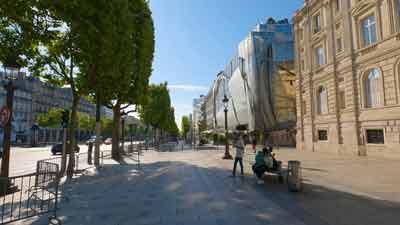
I’ll say banally: the Champs Elysees is a landmark as similar in mega-popularity as the Eiffel Tower of France. Thousands of people come here every day.
The mystery of the name
I have always wondered what kind of strange name “Elysees” is. From the Russian Elisha or what? It turned out no, this is ancient mythology.
According to legend, in the afterlife there is Elisea, fields stretching along the shore of the world river Ocean for the rest of the blessed whom the gods loved. There is always spring, joy and absolute peace here.
Мост Альма
A wide (42 meters) arched structure stretching 153 metres across the Seine and connecting the 7th and 8th arrondissements of Paris. The bridge received its name in honour of a significant event in France: the defeat of the Russian Empire in the Crimean War in which the turning point was the Battle of Alma which took place in 1854 on the banks of the Crimean river of the same name.
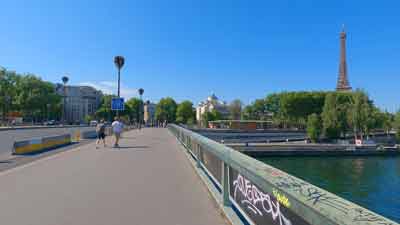
The memorial structure was inaugurated by Emperor Napoleon III in early April 1856 and the bridge was completely renovated after about 115 years to allow transport to pass through it. What I saw today is an example of a feat of engineering which was thought of in the 70’s of the last century.
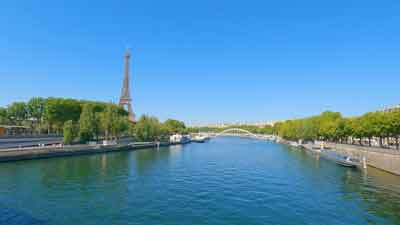
All that remains of the original Alma bridge is the figure of a Zouave (a soldier from the light infantry of the colonial forces of France). Three others (Infantryman, Grenadier and Artilleryman) were taken away in all directions.
George V Street
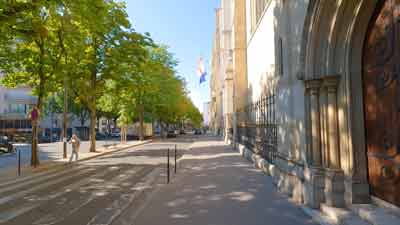
A fairly wide avenue (40 metres) stretching 730 metres from Place Alma (the origin of the name is the same as the bridge of the same name) to the Champs Elysees. By the way, the square appeared two years later than the bridge.
There is an interesting art object right at the entrance: a torch. This is an exact copy of the torch that the Statue of Liberty of the United States of America holds in her right hand. The torch “burning” with copper fire is called the “Flame of Freedom” and it has been “blazing” there since 1989.
The street was renamed George V in 1918. Before that she was also called Alma. The reason for the name change is patriotic. At that time Europe was shaken by the First World War and George V (the British monarch) fought on the side of the Allies.


