


 by
by Louvre
When they say “France”, an immediate and automatic association arises in one’s mind of a shamelessly luxurious palace where millions of tourists flock each year. In 2018 an absolute record for visits was registered: 10,000,000 people. This is the Louvre – one of the grandest repositories of museum objects in the world in terms of size and age. Every centimetre of it is occupied by artistic and historical relics (since 987, when the Capetian dynasty took up the collecting process) of not only France, but also other countries!
In fact, for the sake of unique exhibits, grotesque splendour and incomparable architecture, they go to the Louvre. Where else can you see so many objects in the public domain that are the envy of collectors from all over the world?
But the Louvre is not only synonymous with France, it is one of the main sources of income for Paris, the main “fad” for a foreigner’s mandatory visit, a source of exceptional pride for the French and a rich treasury of artifacts. It has the mystical atmosphere of the chronicle of many eras starting from 1190. The funnel of time, rushing into the long-gone past, tenaciously captures the consciousness of those whose foot has just crossed the threshold of the Louvre. And thus begins a mental journey through centuries, the memory of which has been preserved to this day in amazing works of art!
Let’s start from the beginning: what is the Louvre?
It is a palace and at the same time a museum because its building is located in the ancient royal palace of the same name (Palais du Louvre). But initially it was erected on the foundation of the first fortress built by the King of France, Philip Augustus II (1180). This is the very first king of the country to replace the title “King of the Franks” with “King of France”. During his reign two important metamorphoses occurred that had a beneficial effect on the development of France:
- financial stability appeared (primarily thanks to successful reforms and the seizure of the possessions of King John the Landless of England);
- transformation into the most prosperous and powerful European state.
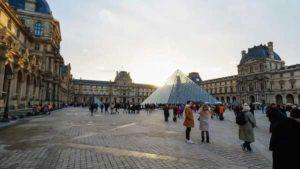
Where did the name “Louvre” come from? It is believed that this is not a proper name, but a word translated into Russian as a combination of two words: “tower” and “watchtower”. This is the meaning of “lauer” – a lemma from the language of the Franks, who are the ancestors of the French. According to another version “Louvre” arose from the non-Latin language of the Germanic tribes. That is why the meaning of this name is slightly different than in the original among the Franks: “fortification.” One way or another both options do not really fit the essence of the Louvre except perhaps indirectly: the museum is guarded day and night in order to prevent theft. By the way, one of them – very loud – occurred on August 22, 1911.
How the Louvre almost lost the Mona Lisa
The legendary Mona Lisa, aka Gioconda, or more correctly “Portrait of Madame Lisa del Giocondo” painted between 1503 and 1505 (the exact date is not known) is exhibited today in the Louvre. This was the case until 22 August 1911 when the painting depicting the wife of a silk merchant, Lisa Gherardini, was stolen by Vincenzo Perugia. As this patriotic Italian later explained, after he was caught thanks to a call to the police who responded to an advertisement for the sale of a relic from a buyer/collector, the motive was the desire to return the relic to its homeland. Well, Gioconda spent six months in the museums of the Apennine peninsula and then returned, carefully guarded back to Paris.
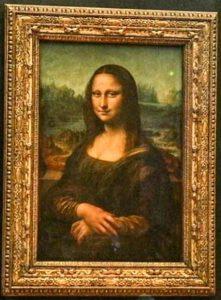
By the way, the famous original Mona Lisa by Leonardo da Vinci ended up in the Louvre simply because Francis I bought it in 1519.
How the Louvre was built
It was built a long time ago – almost 1,000 years! First, as already mentioned, the Great Tower appeared in 1190 – from here servants and knights watched the lowlands surrounding the area stretching along the banks of the Seine around the clock. It was from here that Viking tribes carried out devastating raids.


King Charles the Fifth moved the treasury to the Tower a little less than 200 years later, turning the defensive structure into his residence. It had been destroyed after about two centuries in order to build a luxurious palace on the empty space and only memories remained of the Great Tower. Not only masons, but also creative people were deployed: prominent architects and artists for this purpose.
However, in 1682 the entire large-scale event suddenly “collapsed”: the reason was the re-orientation” of Louis XIV to another palace, Versailles. Another king, Louis XV, decided to turn the Louvre into a museum, but the final implementation of Louis the Beloved plans (his reign, by the way, is considered one of the longest in the world!) was prevented by the French Revolution.

Later, Napoleon I took the “museum baton” over. The construction of the Northern Wing began during his tenure and was completed by Napoleon III, who put an end to the modernization of the Louvre. It opened to visitors on 10 August 1793 with a royal collection numbering a magnificent 2,500 paintings (the collection began to be collected by Francis I).
The museum became in the 21st century what it had been in 1871.
Where to find the Louvre
Of course, in France – or rather, in its capital the Louvre still stands where the Palace of the Kings originally stood in 1880: in the centre of Paris, the oldest municipal 1st arrondissement. Complex buildings are located on the Rue de Rivoli, on the right bank of the Seine (i.e. if you are facing downstream), between two no less remarkable sites of tourist pilgrimage:
- the oldest public park in the French style is the Tuileries Garden (founded by Catherine de Medici in 1564);
- the medieval church of Saint-Germain-l’Auxerrois (a Late Gothic monument, founded in 1220. By the way, its bells on St. Bartholomew’s Night gave the signal for the extermination of the Huguenots invited to the wedding of Henry of Navarre and Marguerite de Valois).
If someone wants to write a letter to the museum then it must be sent to the official address: Palais Royal, Musée du Louvre, 75001 Paris, France. But it is much better to go there in person.


What to see at the Louvre
Literally, everything beautiful that the hands of talented creative craftsmen create:
- paintings;
- household items;
- sculptures, etc.
It’s impossible to see all this in one visit! Experts claim that the exhibits collected in richly furnished halls belong to the entire geography stretching from Western Europe via Iran and Greece to Egypt and the Middle East.
A similar totality applies to the time periods of the collections presented in the Louvre:
- since antiquity;
- up to 1848.
The latest European art covering the period from 1848 to 2022 is not in the Louvre. Such artifacts are kept in two other historical heritage sites:
- Orsay Museum;
- Center Georges Pompidou.
By the way, the situation is similar with collections from other continents:
- Asian ones are exhibited in the Guimet Museum;
- American, African and Oceanian – in the Quai Branly Museum.
However, among the exhibits of the Louvre itself are collections of nine semantic categories:
- Ancient East, Greece and Egypt;
- Sculptures;
- Etruria and Rome;
- Art of Islam;
- Art objects;
- Fine and graphic arts
- History of the Louvre.

But let’s return to the Louvre again: it is precisely because of its gigantic diversity that it is considered a universal museum because it has literally everything that attracts the attention of a person who is at least somewhat interested in art in its material manifestation.
Louvre: 8 blatantly interesting facts
- This is the most popular art museum on planet Earth.
- The Louvre has another status: the richest museum in the world. The budget for 2019 is 243,000,000 euros.
- The Louvre brings very decent income to the Paris treasury: for example, in 2019, tickets were sold for almost 100,000,000 euros.
- Maintaining a museum is not cheap! Every year, despite good revenue, the Louvre receives government subsidies: in 2019 they amounted to 94,000,000 euros.
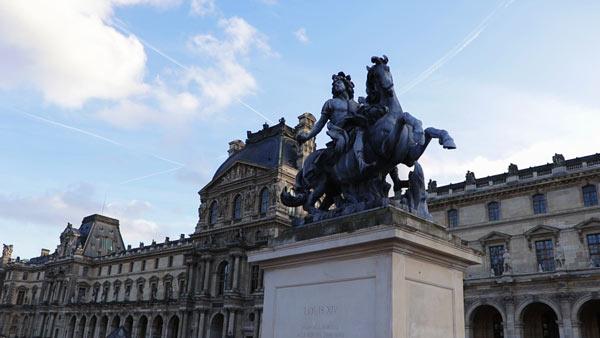
- The palace’s landmark – the equestrian statue of Louis XIV – symbolizes the start of the so-called historical axis of Paris;
- The first fortress of the Louvre was built in a place called “Lupara” – philologists are still arguing about its meaning. According to one hypothesis, Lupara comes from the Latin “lupus” (“wolf”), since packs of wolves lived there.
- The most famous sculpture of the Venus de Milo ended up in the Louvre due to the fact that it was first found by the Turks in 1820 and then sold to the French ambassador.
- The Louvre has 300,000 objects, but only a tenth (35,00) are on display. The rest are in storage: rotation occurs every 3 months for reasons of extreme care.


