by
by 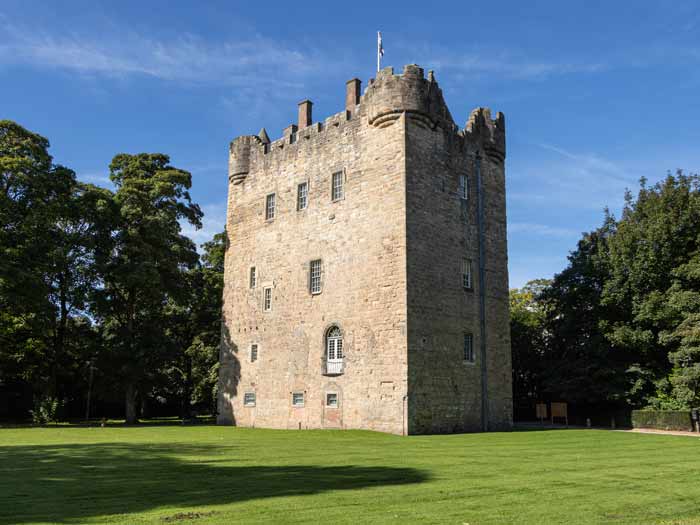
In Clackmannanshire, in the central part of Scotland is a small, but very picturesque and interesting town known for its ancient monuments called Alloa. It is in this territory that one of the oldest and largest towers called Alloa Tower stands which has survived to this day. Formerly the ancestral residence of the powerful Erskine family, today it is not only an architectural monument with a centuries-old history, but also a place where interesting exhibitions are held, weddings are celebrated and creative evenings are organised.


Alloa Tower was built in the 14th century. David II gave the estate to Robert Erskine, the Great Chamberlain of Scotland in 1368. The Erskine family who would later become the Earls of Mar hold an important place in Scottish history as they were trusted assistants to the Stuart kings. Members of the Erskine family often acted as guardians to the royal children.


The Tower was originally part of a fortified line of buildings, the main purpose of which was to protect the Firth of Forth. However the building underwent major changes and in the early 14th century it was converted into a fortified house with three floors and a large hall. The next important stage in the transformation of the tower was its expansion which took place in the 15th century. A fourth floor and an attic was built.
In the 17th century, after further reconstruction, the tower received a large window and an entrance in the Renaissance style. John of Ersk, the sixth Earl of Mar, built a luxurious mansion in 1710 and the tower itself was included in the architectural ensemble as an extension. In 1801 the mansion burned down completely. In 1838 a new palace was built in its place which was demolished in the 1960’s. But the tower was saved and has been preserved in its original form to this day.
James Erskine, then 14th Earl of Mar, put the building into trust and under the management of Clackmannanshire Council in 1988. The Council and the National Trust for Scotland jointly launched a project to restore Alloa Tower. The building was fully restored and in 1997 the Queen reopened it to the public.

Alloa Tower architecture
Alloa Tower is built in traditional Scottish style. The tall four-storey building with an attic is crowned with a parapet made in the form of a crenellated fence. Open “circles” are located at each corner of the roof, giving the building’s appearance an original look. The height of the tower is 21 metres. The building is made of rubble and its most distinctive feature is its very thick walls.

There are various rooms inside the tower, the Great Hall is decorated with a painted ceiling and an Italian staircase. The interior of the tower is decorated with luxurious furniture of the 18th century, personal belongings of King James VI, household items of the Scots and elements of medieaval architecture. On the first floor of the building is a round opening through which one can get into an underground pit which was used as a dungeon. From the top of the tower there are breathtaking views of the nine counties spread around.

Today, the Alloa Tower is a museum and a venue for organising and holding various events and exhibitions.

What is life like in the town of Alloa?
The town of Alloa is a small town in Scotland located on the northern bank of the River Forth. Clackmannanshire is only 3km to the west of Alloa, and Stirling is 11km to the east. Today, the town has a population of 10,000.

The town got its name Alloa from a Gaelic phrase that translates as “fast water”. The first mention of the town dates back to 1398. In that year King Robert III granted Sir Thomas Erskine the barony of Alloa. The Erskine family improved the settlement on this site and founded a local church.

John Erskine made a great contribution to the development of the town. As the 6th Earl of Mar he contributed to the development of the harbour in the town which led to the small Alloa becoming a customs port in 1713. Glasgow merchants began to store sugar and tobacco in the town’s warehouses which was then exported to Europe. Coal mining in Clackmannanshire provided powerful impetus for the rapid industrial growth of the town. In the mid-19th century, 6,440 people lived in Alloa. However, at the beginning of the 20th century, the town’s development slowed down. The city port was closed in 1950 and the railway station was closed in 1960. Today, the main economic sectors of the town is glass production and the textile industry.

Despite the fact that Alloa is no longer the main port town of Clackmannanshire today, this place still has its own distinctive character and spirit which attracts hundreds of tourists every year. The city streets have preserved numerous buildings of ancient Scotland, architectural monuments and cosy squares where you can pleasantly spend time after a walk.

The town’s architecture is not replete with modern glass shop windows and advertising posters. Cosy cafes and shops can be found on the town’s cobbled streets and the facades of buildings look as if they were welcoming counts and kings just yesterday, becoming witnesses to historical events. A walk along the town’s cobbled streets leaves the most pleasant impression and the atmosphere of cosiness and warmth that reigns in the town sets you up for pleasant pastimes.